The short answer: a foreign Visa or Mastercard is still not a universal tap-to-ride card in Korea. For the simplest nationwide backup, buy a physical T-money card and load it with Korean won cash. If your phone and payment card are compatible, Mobile Tmoney can remove the cash step. If you will make many eligible trips inside Seoul, a 1-, 2-, 3-, 5- or 7-day Climate Card can be better value. For one or two Seoul subway rides, a single-journey ticket may be easier than setting up any reusable card.
Checked July 21, 2026
This guide reflects the Korea Tourism Organization’s May 2026 transport-payment chart, Seoul’s March 17, 2026 rollout of international-card ticket machines, and the VisitKorea Mobile Tmoney listing last updated in June 2026. Acceptance can still depend on the machine, phone, app version, card network and issuing bank, so keep one backup method.
Choose your Korea transit payment in 60 seconds
| Option | Purchase or issue | Top up or activate | What you tap | Best for |
|---|---|---|---|---|
| Physical T-money | Buy the card with Korean won cash at a participating convenience store or subway service office | Load stored value with Korean won cash; the May 2026 KTO guide says foreign-issued cards are not accepted for purchase or top-up | The physical T-money card—not your bank card | Nationwide travel, mixed cities and a dependable backup |
| Mobile Tmoney | Install the official app and issue a mobile transit card on a compatible phone | VisitKorea lists supported international Mastercard, American Express and UnionPay cards; actual compatibility can vary | Your configured phone at the transit reader | Travelers who confirm their phone and card work before relying on them |
| Climate Card short-term pass | Buy the KRW 3,000 physical card at a listed seller or eligible new machine on Seoul Metro Lines 1–8 | Load a 1-, 2-, 3-, 5- or 7-day pass. Eligible new machines accept international cards such as Visa and Mastercard | The physical Climate Card at both entry and exit | Frequent eligible subway and Seoul-bus trips during consecutive calendar days |
| Single-journey ticket | Buy one ticket for one journey at a compatible ticket machine | No top-up; buy a new ticket for the next journey | The issued single-journey ticket—not your foreign bank card | One or two rides, or a fallback when another method fails |
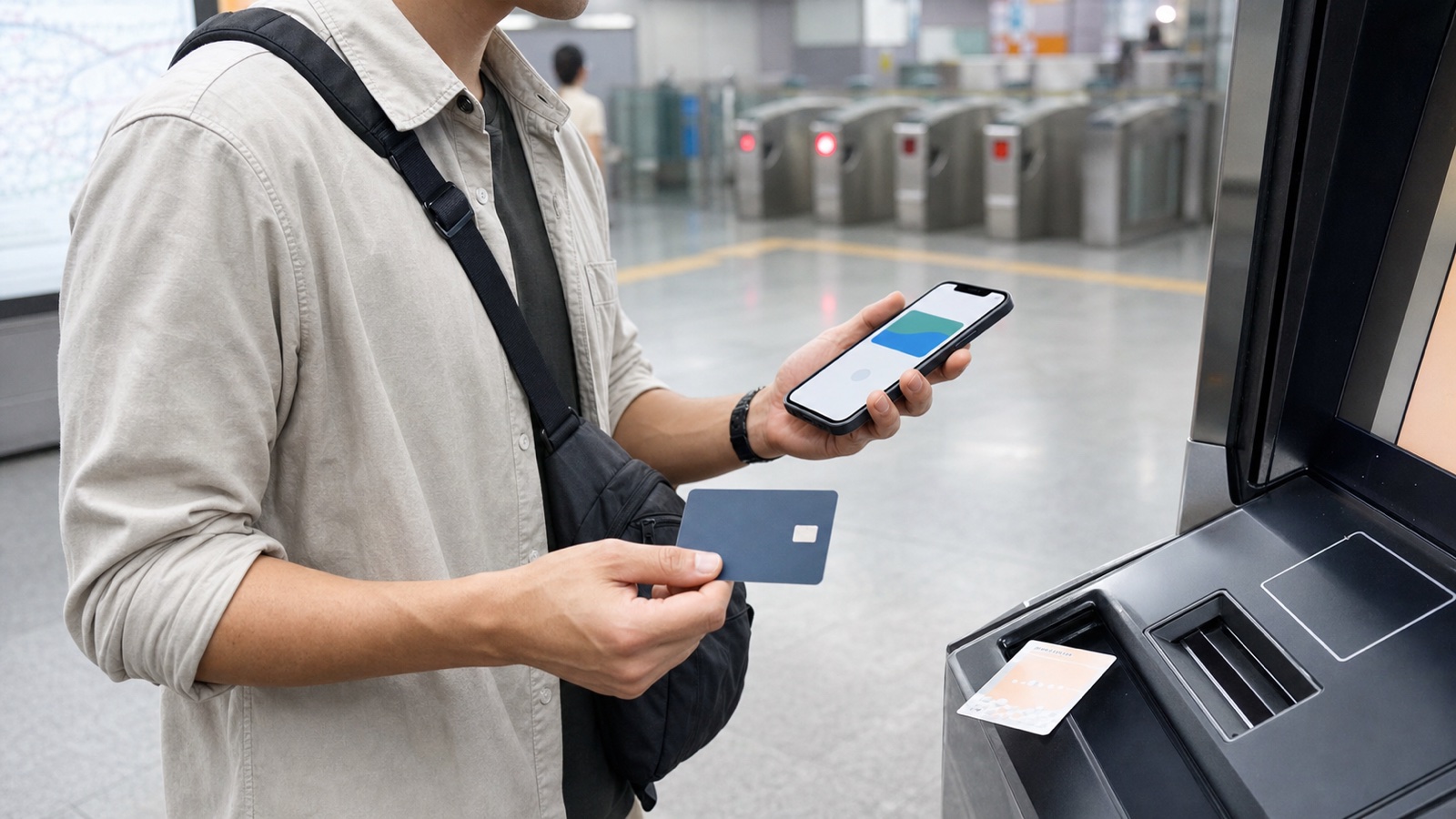
The key distinction: “foreign cards accepted at the machine” does not mean “foreign cards can be tapped at the gate.” The bank card pays the machine. The T-money card, Mobile Tmoney credential, Climate Card or single-journey ticket is what opens the gate.
Do not mix up purchase, top-up and tap
Most contradictory advice about Korean transit payments describes three different transactions as if they were one. Check each action separately:
- Purchase or issue: obtain the physical card, mobile credential or single-journey ticket.
- Top up or activate: add pay-as-you-go value to T-money or load a dated pass onto a Climate Card.
- Tap to travel: present the transit product—not necessarily the payment card used at the machine—to the subway or bus reader.
A shop may sell a card but use different rules for adding its transit balance. A subway machine may accept your overseas Visa to sell a short-term Climate Card pass but still reject that same Visa at the gate. Mobile Tmoney may accept one international card network while another card or device fails. This is why a simple claim such as “Korea accepts foreign cards for transit” is too broad to be useful.
Option 1: physical T-money is the safest general-purpose choice
A physical T-money card is a reloadable, pay-as-you-go transit card. It is useful across a much wider area than a Seoul-only pass and can be used on participating buses, subways and other affiliated services. It is usually the easiest recommendation for a traveler visiting Seoul and another city such as Busan or traveling beyond the Climate Card service area.
How to buy and load a physical T-money card
- Prepare Korean won cash before you need to board. Do not wait until you are standing at a cash-only reload machine with no balance.
- Look for T-money at a participating convenience store such as GS25, CU, 7-Eleven or emart24, or ask at an eligible subway customer service office.
- Pay for the card itself. Standard designs are commonly listed around KRW 3,000–5,000, but special designs can cost more. The card purchase price is separate from travel value.
- Tell the clerk how much cash you want to load, or add cash at a subway reload machine.
- Keep the card separate from other contactless cards and tap it at the reader when entering and leaving.
The KTO’s May 2026 chart states that foreign-issued credit cards are not accepted for the purchase or top-up of the standard physical prepaid T-money card and labels that flow cash only. Carry enough won for the card and initial balance rather than making an urgent journey depend on an unverified exception.
Can I tap my overseas Visa or Mastercard directly?
Not as a general Seoul subway or bus payment method. The May 2026 KTO guide specifically distinguishes accepted foreign-card purchases from transit-gate payment and says overseas cards are not accepted for direct tap payment on ordinary buses or AREX card readers. Use a transit card or ticket that the system recognizes.
Option 2: Mobile Tmoney can remove the physical-card step
VisitKorea describes Mobile Tmoney as an Android and iOS app that issues a mobile transportation card. After the mobile balance is loaded, a compatible phone can be tapped on the reader without opening the app. The June 2026 listing says the app supports international credit cards including Mastercard, American Express and UnionPay.
That official listing is useful, but it is not a guarantee that every phone, regional app-store account, operating-system version or issuer will work. Visa is not included in that specific VisitKorea list. App availability, identity checks, NFC behavior and supported cards can change independently. Treat Mobile Tmoney as your primary method only after you have successfully issued the mobile card and loaded a small test amount.
Mobile Tmoney setup checklist
- Download the official app from the app-store link provided by VisitKorea.
- Confirm that the app is available for your device and region.
- Complete the traveler or account setup shown in the current app.
- Add a small balance with a supported international card.
- Enable the phone settings required by the app, including NFC where applicable.
- Keep the device charged and have a physical or single-ticket fallback.
Do not place a physical T-money card directly against the phone or keep several contactless cards together when tapping. The reader may detect the wrong credential or return a card-clash error.
Option 3: the Climate Card can be economical for intensive Seoul travel
The Climate Card is an unlimited-use pass for eligible Seoul public transportation during its validity period. Short-term visitors can choose a 1-day pass for KRW 5,000, 2-day pass for KRW 8,000, 3-day pass for KRW 10,000, 5-day pass for KRW 15,000 or 7-day pass for KRW 20,000. A physical card is purchased separately for KRW 3,000.
This article’s international-card machine flow refers to the physical short-term Climate Card. Seoul also offers a mobile Climate Card for eligible Android users, but the city lists separate registration and domestic-payment requirements for that product. Do not assume that an international card supported for ordinary Mobile Tmoney balance automatically buys a mobile Climate Card pass.
The short-term pass begins on the date it is loaded, not 24 hours after the first tap. Seoul’s example treats a one-day pass loaded on Monday as valid through the final eligible service on Monday. It cannot be loaded in advance for a later start date, so do not activate it on arrival night if your intensive sightseeing starts the next morning.
What changed on March 17, 2026?
Seoul installed 440 new transit card vending machines at 273 stations on Seoul subway Lines 1–8. At those eligible machines, foreign visitors can use internationally issued credit or debit cards such as Visa and Mastercard to purchase Climate Cards and load the short-term 1-, 2-, 3-, 5- and 7-day passes. The same rollout added international-card purchase of single-journey tickets. Supported mobile-payment options are shown on the machine.
Seoul reports an average service fee of approximately 3.7% when an internationally issued credit or debit card is used for the eligible purchase or recharge. Your card issuer may separately apply foreign-exchange or overseas-transaction charges. Check the amount on screen before confirming instead of assuming every card will produce the same total.
Climate Card coverage is not the whole Korean transport network
The short-term pass is designed around Seoul. It covers participating Seoul subway sections and Seoul-licensed buses, but excludes services such as the Sinbundang Line, intercity and airport buses, non-Seoul-licensed buses and subway travel outside the published service range. Short-term passes also exclude Ttareungi and the Hangang Bus.
Incheon Airport creates an especially important exception: a Climate Card can be used to exit at Incheon Airport Terminal 1 or Terminal 2 after boarding within the eligible service area, but it cannot be used to board at the airport stations. An arriving traveler therefore needs another payment method for the first trip from Incheon Airport.
When is the Climate Card worth it?
Choose it when all three statements are true:
- You will make several eligible rides on most days of the pass.
- Your planned routes remain inside the Climate Card service area.
- You will use the pass on consecutive calendar dates beginning when it is loaded.
Do not select it only because the word “unlimited” sounds convenient. A traveler making two rides a day, taking airport buses, using the Sinbundang Line or leaving Seoul frequently may spend less and encounter fewer restrictions with ordinary T-money.
T-money and the Climate Card do not replace a separate intercity ticket. If you are leaving Seoul, use the foreigner-friendly KTX booking guide for the long-distance train, then use your local transit product after arrival.
Option 4: a single-journey ticket is a useful low-commitment fallback
A single-journey ticket solves one immediate trip. On the 440 eligible new machines across Lines 1–8, an international Visa or Mastercard can pay for that ticket. You then tap the issued ticket at the gate. You do not tap the payment card that bought it.
This option is sensible if you will take only one or two rides, if your mobile setup fails, or if you reach a station without enough cash for a physical T-money top-up. It is less convenient for repeated travel because you must select and purchase the next journey again. Follow the machine’s current instructions for fare, destination selection and any deposit or return process.
Best setup after landing at Incheon Airport
Do not make the Climate Card your only plan for the inbound airport trip. Save your hotel with the Korean address and NAVER Map workflow, then use one of these arrival flows:
Lowest-risk setup
- Withdraw or exchange a modest amount of Korean won.
- Buy a physical T-money card at a participating airport convenience store and load it with cash.
- Use it for the AREX All-Stop Train or another eligible transit service.
- If a Climate Card will save money, buy and load it after reaching an eligible Seoul station.
Cash-light setup
- Set up Mobile Tmoney before departure or on airport Wi-Fi.
- Confirm the app has issued a mobile card and accepted a small top-up.
- If the mobile method does not work, buy an AREX or other airport ticket at the operator’s machine or counter with an accepted foreign card.
- Set up your preferred Seoul transit product after arrival in the city.
The KTO May 2026 chart says AREX ticket machines and counters accept foreign-issued credit cards, but a foreign card is not a direct tap credential at the AREX reader. Keep “buying an AREX ticket” separate from “tapping a bank card at the gate.”
Match the payment method to the route: compare the full airport journey to Myeongdong or the full airport journey to Hongdae before buying a pass that may not cover the first ride.
Troubleshooting foreign-card and transit-card problems
The gate rejects my foreign bank card
This is expected on ordinary Seoul subway and bus readers. Buy or load a recognized transit product: physical T-money, a working Mobile Tmoney credential, a Climate Card or a single-journey ticket.
The machine has no international-card option
You may be using an older machine, a station outside the 273-station rollout, a non-Seoul operator’s machine or a menu for a different product. Look for the new-machine international-card markings, ask station staff, try another eligible Lines 1–8 station, or use cash and physical T-money.
My overseas Visa works at the Climate Card machine but not in Mobile Tmoney
These are separate payment systems. Seoul explicitly names Visa and Mastercard for the new Climate Card and single-ticket machines, while the June 2026 VisitKorea Mobile Tmoney listing names Mastercard, American Express and UnionPay. Use the acceptance list for the product in front of you, not a list copied from another product.
The Mobile Tmoney app or top-up fails
Check app updates, device compatibility, NFC settings, card-network support and your issuing bank. Repeated retries can trigger fraud controls, so switch to a physical card or single-journey ticket rather than making an urgent trip depend on one app.
The Climate Card is rejected on my route
Check the current service-area map and the operator of the bus or subway section. A route can look like part of the Seoul network but include an excluded line, non-Seoul bus or out-of-range destination. Ask station staff before passing the gate if the route is unclear.
The reader detects more than one card
Remove the transit card from your wallet and tap it alone. Keep Mobile Tmoney away from a physical transit card when presenting the phone. This also helps prevent paying with or recording the wrong credential.
Common mistakes to avoid
- Trying to tap an overseas credit card directly: international-card acceptance at a machine is not open-loop gate payment.
- Assuming physical T-money can be loaded with that card: the May 2026 KTO guide describes physical-card purchase and top-up as cash only.
- Activating a short-term Climate Card too early: its clock begins on the loading date, not the first major sightseeing ride.
- Expecting to board AREX at Incheon Airport with a Climate Card: the airport stations are exit-only for this pass.
- Using an old Climate Card article: overseas-card machine acceptance changed in March 2026, while some older official pages still describe domestic-card or cash-only rules.
- Assuming one supported network guarantees every card: issuer security checks, app region and terminal communication can still cause failure.
- Buying an unlimited pass without checking coverage: out-of-range routes can erase the convenience and savings.
- Loading too much onto T-money: add a practical amount and review the current refund process before your final day.
Frequently asked questions
Can I tap a foreign Visa or Mastercard directly on the Seoul subway?
No general direct-tap system is described in the May 2026 KTO guide. Use the card to pay an eligible machine, then tap the T-money card, Mobile Tmoney credential, Climate Card or single-journey ticket issued for travel.
Can I buy and top up a physical T-money card with a foreign card?
Plan on Korean won cash. The KTO’s May 2026 chart says foreign-issued cards are not accepted for standard physical T-money purchase or top-up. Do not confuse this with the new machines that accept overseas cards for short-term Climate Cards and single-journey tickets.
Which international cards does Mobile Tmoney accept?
The VisitKorea page last updated in June 2026 lists Mastercard, American Express and UnionPay. The actual app can change and compatibility can depend on the issuer, device and app-store region, so confirm inside the current official app before relying on it.
Do the new foreign-card ticket machines accept Visa and Mastercard?
Seoul’s March 17, 2026 announcement specifically gives Visa and Mastercard as examples. The rollout covers 440 new machines at 273 stations on Lines 1–8. A logo does not guarantee every issuing bank will approve every transaction, so keep another card or cash.
What is the international-card fee at the new machines?
Seoul states that an average service fee of approximately 3.7% applies to eligible purchases or recharges made with an internationally issued credit or debit card. Your issuer can add a separate foreign-transaction or currency-conversion charge.
Can I use a Climate Card from Incheon Airport to Seoul?
No. The published Climate Card coverage allows a rider who boarded within the eligible area to exit at Terminal 1 or Terminal 2, but does not allow boarding at the airport stations. Use T-money, a mobile transit credential or a separate AREX ticket for the inbound journey.
Does a one-day Climate Card last 24 hours?
No. A short-term pass is based on calendar dates. A one-day pass loaded on Monday is valid through the final eligible service on Monday, not until the same time on Tuesday. Short-term passes cannot be loaded in advance for a later start.
Should I choose T-money or a Climate Card?
Choose ordinary T-money for flexibility, travel outside Seoul and lighter ride counts. Choose the Climate Card when you will take many eligible trips on consecutive days within its service area. List your routes first; the pass with the lower sticker price is not always the lower-cost trip.
Official sources
- Korea Tourism Organization: International Visitors’ Use of Public Transportation and Booking/Payment Services, published May 2026
- Seoul Metropolitan Government: Climate Cards and Single-Journey Transit Tickets Now Accepting International Credit Cards, March 17, 2026
- Seoul Metropolitan Government: Climate Card service area, pass prices and use instructions
- VisitKorea: Helpful Apps & Resources, including Mobile Tmoney, last updated June 2026
- VisitKorea: Transportation Cards, including physical T-money and Climate Card basics
Update history: first fully verified edition prepared July 21, 2026. This article does not guarantee acceptance by a particular phone, card, issuer, machine or route. Official operator information and the labels on the machine in front of you take priority.