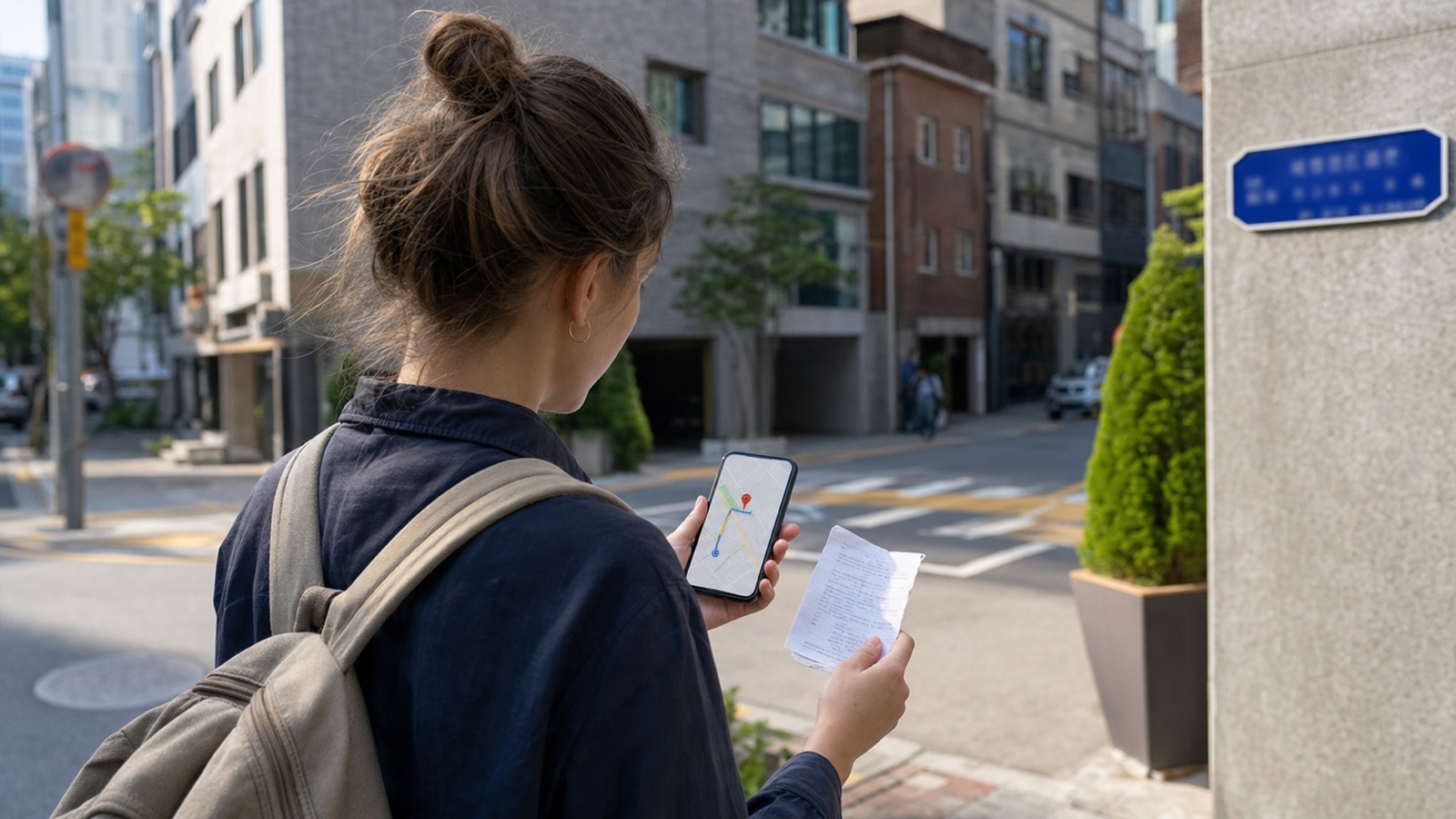
The short answer: if NAVER Map cannot find a Korean place from its English name or a full address copied from another site, search in this order: the exact Korean place name, a shorter Korean road-name or lot-based address, the venue’s Korean phone number, and finally a verified map link or pin. Confirm the branch and opening hours before starting the route.
Checked July 21, 2026
This guide is based on current NAVER and Korea Tourism Organization guidance, Korea’s official road-address system, and live route checks. Repeated traveler reports helped identify the search problem, but they are used only as a discovery signal—not as proof that every English query fails or as a measure of how often it happens. App labels and menu locations can change, so this article does not depend on an invented tap-by-tap interface.
The quickest NAVER Map address-search fix
| If this fails | Try next | Why it helps |
|---|---|---|
| Exact English business name | Exact Korean place name | It is more likely to match the local place record |
| Full translated address | Korean road name plus building number | It removes postal, floor and translated components that are not needed to locate the building |
| Korean road-name address | Korean lot-based address | The place may be easier to identify through its other official address form |
| Either address form | Venue phone number | A branch phone number can distinguish places with similar names |
| Text search | Verified NAVER link or exact pin | It avoids retyping and romanization differences |
| Correct pin | Official hours and entrance check | A location can be right while the branch is closed, moved or entered from another side |
Why an exact English name may not return the place
NAVER Map supports English, and the Korea Tourism Organization currently recommends it as a multilingual route-finding app. That does not mean every Korean business has a complete English alias in its place record.
A café, clinic, guesthouse or restaurant can use an English marketing name on Instagram or a booking platform while its local listing is registered under a Korean name. Romanization also varies. The same Korean syllables can appear with spaces, hyphens or different English spellings, and a branch label such as “Hongdae,” “Yeonnam” or “Main Store” may be translated differently by separate services.
This is why copying an English name exactly is not always the most exact search. The local Korean name is often the stronger identifier. NAVER has continued to improve multilingual place search, reviews and filters, but its own 2024 announcement also described multilingual search accuracy and convenience as an area for further improvement.
Why a full copied address may fail
A hotel or booking confirmation may give you a long English mailing address containing a postal code, province, city, district, neighborhood, building name, floor and room. Those details are useful for mail or check-in, but they can be too much for a map search—especially after automatic translation changes the order or spelling.
Korea commonly displays two address forms:
- 도로명주소 (road-name address): a road name followed by the building number.
- 지번주소 (lot-based address): a neighborhood or locality followed by a parcel number.
Both can point to the same building. NAVER’s official help page says its road-name address results reflect information from the Ministry of the Interior and Safety’s road-name address system. For a map search, the building-level Korean address is normally the useful core. A room, unit, tower, floor, postal code and “Republic of Korea” can be kept in your booking note but removed from the first search attempt.
Do not translate an address word by word.
First look for an address already written in Korean by the hotel, venue, booking service or official road-address system. Translation is a fallback. Road names, district names and building names are identifiers, so a natural-sounding English translation can be less searchable than the original Korean text.
The step-by-step workaround ladder
1. Search the exact Korean place name
Start with the business or venue name in Hangul. Include the Korean branch label when one is supplied. This is particularly important for chains: the brand alone may return dozens of places, while the branch name identifies the correct district, station or department-store location.
After a result appears, compare at least two identifiers before saving it: the district or nearby station, the phone number, the street address, or a photo of the storefront. Do not choose the first familiar logo when several branches have nearly identical English names.
2. Reduce the Korean address to its searchable core
If the name fails, paste the Korean road-name address and remove the postal code, country, floor, room and extra delivery instructions. Keep the road name and building number. If the confirmation provides a Korean lot-based address instead, try that as a separate search rather than combining both forms in one line.
If both addresses are shown, test them one at a time. Do not mix the road name from one form with the parcel number from the other. Preserve meaningful hyphens in building or lot numbers.
3. Search the venue’s phone number
A Korean landline or mobile number is often a useful branch identifier. Copy it from the venue’s official website, booking confirmation or verified local listing. If the source shows the international format beginning with +82, also keep the domestic form supplied by the venue; Korean listings often display the domestic number with its leading zero.
A phone match is not enough on its own. Compare the returned name and location, because a hotel group, hospital or restaurant company can use a central call number for multiple locations.
4. Use a verified map pin when text search remains ambiguous
If the venue, host, hotel or booking service sends a NAVER Map link, open that link directly instead of retyping the address. If it supplies a pin in another map, compare the pin against the Korean street address and the building outline. A pin is especially useful for parks, markets, trail entrances, temporary events and large complexes where one postal address can cover several entrances.
Seongsu pop-ups are a common version of this problem: an event name, host building and reservation page may use different labels. Follow the Seongsu pop-up reservation and walk-in workflow, then save the exact building and entry rule together.
For a mall, station or university, the destination building is only part of the problem. Save the entrance, gate, floor or nearest exit information separately. A pin at the center of a large property may not lead you to the visitor entrance.
5. Save the verified link and the Korean text
The Korea Tourism Organization notes that NAVER Map has a bookmark feature. Once you have the correct place, save it before the travel day. Also keep a small offline note containing:
- the Korean place name;
- the Korean road-name or lot-based address;
- the branch phone number;
- the verified map link;
- the nearest station exit or recognizable entrance; and
- a screenshot that remains readable without mobile data.
This backup is more useful than a screenshot of an isolated pin with no name. It gives a hotel desk, taxi driver or passerby enough context to help.
6. Verify hours, break time and last entry
Finding the right pin is not the end of verification. Compare NAVER’s displayed hours with the venue’s official notice or booking confirmation, especially for small restaurants, clinics, museums and seasonal attractions. Check for a weekly closing day, afternoon break, last order, last admission, holiday notice or reservation-only period.
Recent traveler reports are useful for noticing a possible move or closure, but they are not the operating authority. When the trip would be costly to repeat, contact the venue or ask your hotel to confirm.
How to get the Korean name and address
Use the booking confirmation first
Many hotel, clinic, tour and restaurant confirmations contain a Korean name or address below the English version. Expand the property details, downloadable voucher or check-in instructions. Copy the Korean line exactly and keep the reservation name beside it so you can confirm the branch. If the address is for immigration paperwork, return to the Korea e-Arrival Card vs K-ETA guide after verifying it.
Ask the hotel, host or venue
A useful request is: “Please send the exact Korean place name, Korean road address, phone number and NAVER Map link.” This is clearer than asking only for “the address,” which may produce the same English mailing line that already failed.
Check the venue’s official Korean page
Look for the contact or location section on the venue’s own website or official booking page. For a chain, confirm the branch page rather than copying the company headquarters. Treat an unofficial blog, social profile or old directory as a lead until the phone number and location match a current official source.
Use Papago for text or camera recognition
The Korea Tourism Organization’s app guide says Papago can translate typed text and recognize text from images, handwriting, webpages and speech. That makes it useful when the Korean address appears only in a booking screenshot, storefront photo or printed voucher.
- Capture a sharp, straight image with the full Korean line visible.
- Use Papago’s text or image recognition to extract the Korean characters.
- Compare all numbers, hyphens and branch words with the original image.
- Paste the Korean output into NAVER Map without translating it back to English.
Camera recognition can confuse similar characters or drop punctuation. If one digit differs, the result can be another building. Use the extracted text as a search aid, then verify the pin, phone number and venue name.
Plan the route, not only the destination
After finding the correct place, check the route for the day and time you expect to travel. For public transport, note the station, exit, bus stop and final walking leg. A correct destination can still produce a poor trip if you select a similarly named stop, the wrong branch or a route after the final service.
Use NAVER Map for local place records and route guidance, then pair time-sensitive travel with the official operator. A map app is not the authoritative source for a final train, temporary closure, airport-bus platform, admission cutoff or reservation condition.
For public transport, first choose the transit card that covers the route. For long-distance rail, confirm the exact terminal with the KTX station-name warning guide. Then save the Korean station name and local route in your map app; a city name alone is not enough.
Keep one independent backup
- Save the Korean destination text outside the map app.
- Keep the venue phone number and booking reference.
- Take a screenshot of the final walking segment and entrance note.
- For an important appointment, allow time to ask the hotel or information desk for help.
- If NAVER is unavailable, compare the Korean name and address in another local map rather than rebuilding the destination from an English nickname.
Does Google Maps work in Korea in 2026?
It works for some useful tasks, but coverage and route modes remain uneven as of July 21, 2026. Do not describe it as completely unusable, and do not assume every walking, driving or transit request will resolve.
On February 27, 2026, the Korean government conditionally approved Google’s request to export 1:5,000 map data under security requirements. That decision creates a path to broader functionality, but an approval date is not the same as a guarantee that every feature has reached every user.
In our July 21 live check, Google Maps produced public-transit routes from both Incheon Airport terminals to Myeongdong, while a short walking-directions request in central Seoul returned a coverage error. Results can change by mode, destination, app version and rollout. A sensible 2026 workflow is:
- Use Google Maps when it successfully finds the English place, reviews or a supported route.
- Verify that the requested travel mode actually opens with usable directions.
- Copy or confirm the Korean name and address.
- Keep NAVER Map or another verified local-map link as the route backup.
- Use the official operator for schedules, fares, platforms and service notices.
For the latest mode-by-mode live test, including what still works and why the 2026 map-export approval is not a launch date, use the Korea Google Maps 2026 guide.
Troubleshooting common failures
| Problem | Likely issue | Best next action |
|---|---|---|
| No result for an English name | The English alias or spacing does not match the local record | Use the exact Korean name from the official venue or booking |
| No result for a long address | The query contains translated, postal, floor or room details | Search only the Korean road name and building number |
| Several identical results | Chain branches share a brand name | Compare branch label, district, station and phone number |
| Pin and address disagree | One source may be stale, translated incorrectly or centered on a complex | Confirm against the venue and Korea’s official road-address record |
| Correct building, wrong entrance | A large property has several gates or floors | Save the gate, exit, floor and entrance note separately |
| Place appears closed | Break time, weekly closure, move or stale hours | Check the official notice and contact the venue when the trip matters |
| Search worked yesterday but not today | Connection, temporary service issue or listing update | Open the saved link, use the offline note, then retry on a stable connection |
| Planning abroad shows odd transit options | The selected date or Korean local time may not match the intended trip | Recheck the date, departure time and service day before saving |
Frequently asked questions
Can I search NAVER Map in English?
Yes. NAVER and the Korea Tourism Organization list English among the supported languages. English coverage is useful but not complete for every place alias, branch label or detail. When a precise result fails, use the Korean name or address rather than assuming the place is missing.
Why does an address copied from Google Maps fail in NAVER Map?
The copied line may use an English spelling or address order that does not match the Korean local record, or it may include more detail than the map needs. Find the Korean road-name or lot-based address, remove postal and room details, and search the two address forms separately.
What is the difference between a road-name and lot-based address?
A road-name address identifies a building by road and building number. A lot-based address identifies it by locality and parcel number. They can describe the same building. If a booking shows both, either may work, but do not combine fragments from the two systems.
Do I need a Korean phone number to search NAVER Map?
Basic place and route searching is separate from phone-based identity verification. A venue’s Korean phone number is useful as a search identifier. Account, reservation, ordering and payment functions can have additional requirements that change independently of map search. If a supported NAVER service asks for identity after you find the place, follow the NAVER passport-verification guide for foreign visitors.
Should I translate the Korean address into English before searching?
No. Keep the original Korean text for the NAVER search. Use Papago to understand the line or extract Korean text from an image, but paste the verified Korean characters into the map. Check every number against the source.
Can I rely only on Google Maps in Korea now?
That depends on the exact place and mode. Some searches and transit routes work, while some walking or driving requests may still be unavailable or incomplete. Test the actual route and retain the Korean destination plus a local-map backup.
How do I make sure I found the correct branch?
Match at least two branch-specific details: district or station, phone number, road address, floor, storefront photo or official booking name. A familiar brand name alone is not enough in Seoul, Busan or another city with many branches.
What should I show a taxi driver or hotel desk?
Show the Korean place name, Korean building-level address, phone number and verified pin together. Add a gate or entrance note for a large complex. This gives the helper more than one way to confirm the destination.
Official sources
- NAVER Map Help: road-name and lot-based address search
- NAVER Corp.: NAVER Map service overview
- NAVER Corp.: multilingual NAVER Map usage guide, December 30, 2024
- NAVER Corp.: multilingual reviews, filters and search improvements, October 2, 2024
- Korea Tourism Organization: Helpful Apps & Resources, including NAVER Map and Papago
- Korea Tourism Organization: 4 Essential Apps for Seamless Travel in Korea, May 28, 2026
- Ministry of the Interior and Safety: official Road Name Address Information System
- Korean government: conditional approval of Google’s 1:5,000 map-data export, February 27, 2026
Using the address for a restaurant? Match the exact branch first, then follow the foreign-visitor restaurant reservation guide for CATCHTABLE Global and no-phone-number fallbacks.
Update history: first fully verified edition prepared July 21, 2026. It incorporates NAVER’s multilingual guidance, the May 2026 KTO app guide, the February 2026 Korean map-data decision and live route checks completed on the verification date. Search behavior, place records and route coverage can change; the venue’s current Korean details and official operator notices take priority.