The short answer: Korea is highly card-friendly, but one foreign card is not a complete payment plan. Bring two cards from different networks, know both PINs, enable overseas use, and keep a modest amount of Korean won for physical transit-card purchase or top-up, traditional markets and the occasional cash-only counter.
Checked July 21, 2026
VisitKorea currently says major international networks are accepted at most Korean stores while some traditional markets and street shops remain cash-only. ATM acceptance and fees depend on the machine, network and issuing bank, so this guide uses a backup sequence rather than promising one bank will always work.
The simple payment setup
- Primary card: a credit or debit card with overseas use enabled and no or low foreign-transaction fee.
- Backup card: ideally a different network and issuer, stored separately.
- ATM card: a debit card with international cash withdrawal enabled. Know the PIN and confirm with your issuer whether overseas terminals require a four-digit PIN.
- Small won reserve: enough for the first transit-card load and several small cash-only purchases.
- Phone access: issuer app, transaction alerts and a way to receive security messages.
Choose your mobile setup before leaving airport Wi-Fi with the Korea eSIM, SIM and pocket WiFi guide.
Where foreign cards usually work—and where cash still helps
| Situation | Good first method | Backup | Common mistake |
|---|---|---|---|
| Hotels, department stores, chain shops and most restaurants | International credit or debit card | Second card or Korean prepaid travel card | Accepting home-currency conversion without comparing the rate |
| Traditional markets, small stalls and street food | Korean won cash | Ask before ordering whether card is accepted | Assuming every small vendor has the same policy |
| Standard physical T-money purchase and top-up | Korean won cash | Use an alternative supported mobile or ticket product | Confusing foreign-card ticket machines with direct gate payment |
| AREX, KTX and SRT machines or counters | Foreign-issued card on supported machines | Another card or staffed counter | Assuming a successful rail purchase means the card works at every transit reader |
| Taxi | International card where accepted or a supported taxi app | Cash plus receipt | Leaving before checking the meter and receipt |
| ATM withdrawal | Bank or Global ATM displaying your network logo | Different bank ATM, card or staffed exchange | Repeatedly retrying one rejected machine |
Before flying: five card checks
- Enable overseas purchases and ATM withdrawals in the issuer app.
- Know the daily purchase and withdrawal limits.
- Memorize the PIN; many Korean terminals use a four-digit flow.
- Check foreign-transaction, cash-advance and ATM fees.
- Save the issuer’s international support number somewhere separate from the card.
Do not photograph both sides of a card or store the security code in ordinary notes. Keep the two cards in different secure places so a lost wallet does not remove every payment option.
Pay in Korean won, not your home currency
A merchant terminal or ATM may offer to convert the transaction into your home currency. This is dynamic currency conversion, or DCC. Visa explains that the screen should show the local amount, converted amount, exchange rate and added fee or markup, and that you must be allowed to accept or decline.
Practical default: choose KRW / Korean won and let your card network or issuer handle the conversion, unless you have compared the displayed DCC rate and deliberately prefer it. A familiar home-currency number is not automatically the cheaper option.
Read the entire screen. Buttons can be worded as “with conversion,” “without conversion,” “home currency” or “local currency.” If a merchant converts without permission, keep the receipt and contact the card issuer.
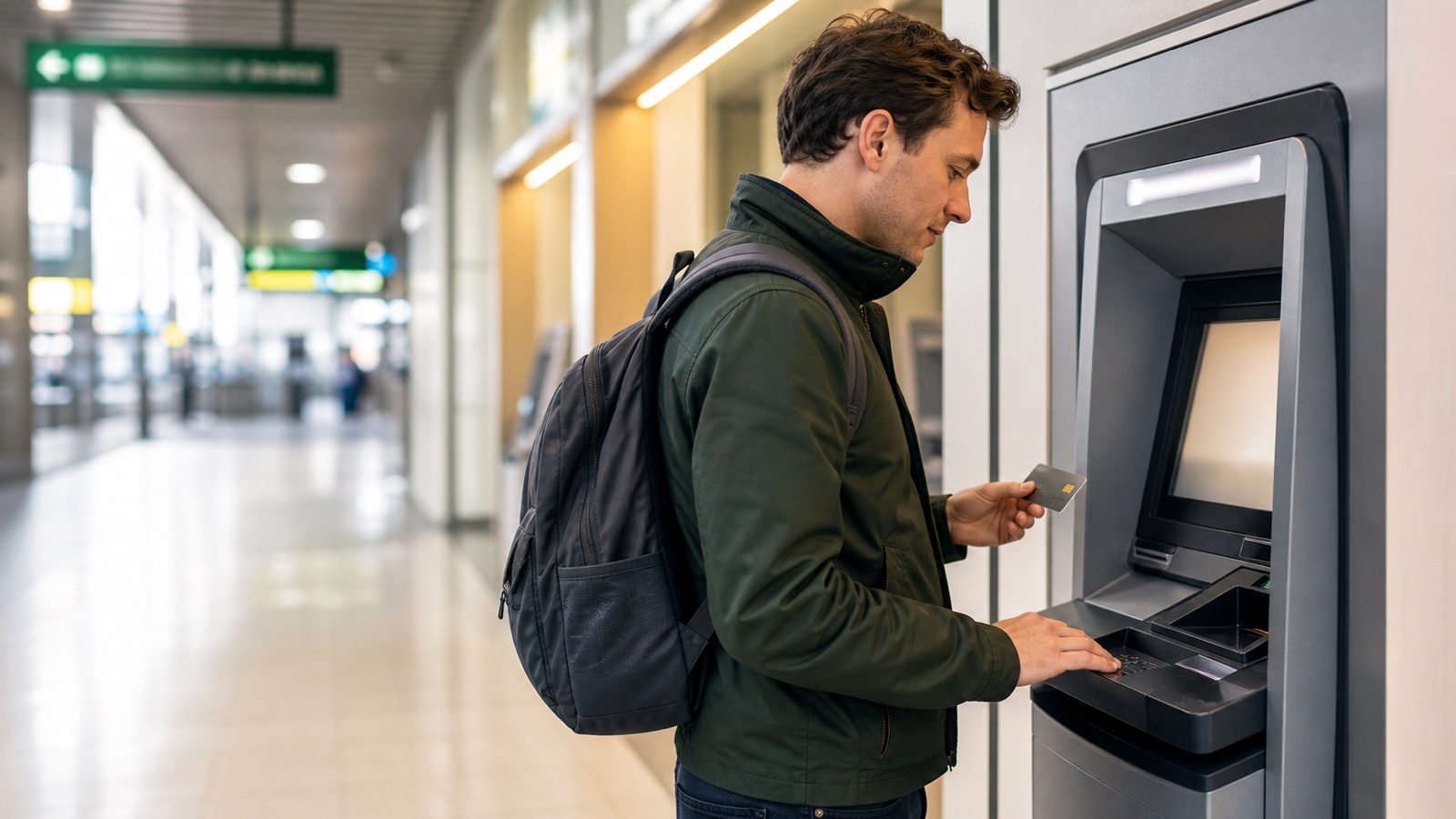
How to withdraw cash from a Korean ATM
- Choose an ATM inside a bank branch, airport, major station or well-lit commercial building.
- Look for Global ATM and the logo matching your card network, such as Visa/PLUS, Mastercard/Cirrus or UnionPay.
- Select the foreign-card or international-card menu when available.
- Choose withdrawal from the appropriate account. For an ordinary bank debit card, this is usually checking/current rather than credit.
- Review the machine fee, withdrawal amount and currency conversion choice.
- Choose KRW rather than home-currency DCC unless you intentionally accept the shown conversion.
- Take the card, cash and receipt before leaving.
The ATM operator may charge one fee and your issuing bank may add another withdrawal or exchange fee. A balance inquiry can also create a charge on some networks. Withdraw a sensible amount per successful transaction rather than making many tiny withdrawals, while avoiding more cash than you can secure.
If the ATM rejects your card
- Stop after one careful retry; repeated attempts can trigger fraud controls.
- Check the network logo and switch to the international-card menu.
- Try a smaller amount that fits both the machine and issuer limit.
- Try another major bank’s Global ATM rather than the next identical machine.
- Open the issuer app to check whether overseas cash withdrawals are blocked.
- Try the backup card or use a staffed exchange counter.
A “Global ATM” label means the machine supports international networks; it does not guarantee every card, issuer or account type. Never ask a stranger to withdraw cash with your card.
How much cash should you carry?
There is no correct amount for every traveler. Carry enough for the first physical T-money card and top-up, one cash-only meal or market visit, and a small emergency. Refill later if necessary. This reduces both ATM fees and the risk of holding a large bundle.
Cash is especially useful for:
- standard physical T-money purchase and reload;
- some traditional-market and street-food vendors;
- small rural businesses or temporary stalls;
- a backup taxi payment when a terminal or card fails;
- coin lockers, deposits or older machines that explicitly require it.
For a taxi, confirm whether the app already charged you before paying the driver again, and keep the receipt until the charge settles. If the total remains unexplained, use the taxi fare check and English reporting guide.
For the exact difference between buying, loading and tapping a transit card, use the T-money versus Climate Card guide.
Airport payment plan
At Incheon Airport, use an official bank, exchange counter or bank ATM if you need won immediately. Current VisitKorea information notes that exchange-counter hours differ and that some airport counters operate longer than ordinary branches. Do not exchange a large amount solely because it is your first chance; compare the displayed rate and service fee.
AREX ticket machines and counters currently accept foreign-issued cards. Standard physical T-money purchase and top-up remain a different transaction and are described as cash-only in the Korea Tourism Organization’s May 2026 transport-payment guide. Decide the actual route first with the Incheon Airport to Seoul comparison.
If normal service has ended, ticket access and taxi surcharges change the decision. Use the late-night Incheon arrival guide before withdrawing extra cash.
Paying for KTX and other intercity travel
KORAIL’s international payment flow can still fail because of issuer approval, 3-D Secure, browser settings or name-entry issues. A foreign card failure does not mean the train is sold out. Switch browser or device, try the official app or another card, then use a supported station machine or staffed counter. The full sequence is in the KTX booking guide for foreign visitors.
Highway buses use a separate system. Before paying, distinguish an express bus from an intercity bus and confirm the exact terminal with the foreign-card intercity bus booking guide.
If a delivery app rejects an overseas card, use the payment fallback sequence in the Korea food delivery guide for foreigners before repeating the same charge.
Card declined at a shop or restaurant
- Ask the merchant to retry with the chip rather than contactless.
- Confirm that the purchase is being charged in KRW.
- Use the second card from a different issuer or network.
- Check the issuer app for a fraud alert or overseas-use switch.
- Use cash only after confirming the final amount and obtaining a receipt where appropriate.
A decline can be caused by the card issuer, terminal connection, merchant category, contactless limit or authentication flow. It is not proof that the business refuses all foreign cards.
Common money mistakes
- Traveling with one card: one issuer block can remove the entire plan.
- Using a credit card for ATM cash without checking: it may be treated as a cash advance with interest and fees.
- Accepting DCC automatically: home currency can include a markup.
- Assuming every transit purchase works the same way: rail ticket, physical T-money top-up and gate tap are separate actions.
- Making repeated failed ATM attempts: switch machine or issuer instead.
- Carrying all cards and cash together: split the backup securely.
Frequently asked questions
Can I travel in Korea without cash?
You can pay by card in most major tourist situations, but a completely cashless plan is fragile. Keep a modest won reserve for physical transit-card loading and cash-only small businesses.
Which ATM works with foreign cards?
Look for a Global ATM and your network logo. Acceptance still depends on the machine, issuer, account and limits, so bring a second card and be ready to try another major bank.
Should I choose KRW or my home currency?
KRW is the practical default because it avoids accepting the merchant or ATM’s DCC conversion. Review the displayed rate and fees before deciding.
Can I top up physical T-money with a foreign card?
Plan on Korean won cash for the standard physical-card purchase and top-up. Do not confuse foreign-card acceptance at selected ticket machines with physical T-money reload or direct bank-card gate payment.
Official and primary sources
- VisitKorea: shopping payments and when cash may be needed
- Korea Tourism Organization: foreign-card transport purchase and tap-payment guide, May 2026
- VisitKorea: airport banks and exchange counters
- Visa: dynamic currency conversion choices and disclosures
- Visa: foreign transactions and ATM fee considerations
Update history: first fully verified edition prepared July 21, 2026. Your card issuer, the ATM screen and the merchant’s displayed acceptance rules take priority because fees and authorization results vary.