The easiest way to be considerate in Korea is simple: let people exit before you board, keep designated seats available for people who need them, follow posted venue rules, and never treat a common habit—such as saving a café seat with a bag—as a guarantee of safety.
Checked July 21, 2026
Transport advice was checked against Seoul Metropolitan Government and Visit Seoul guidance. Café habits are clearly separated from venue policies and official rules. Local signs and staff instructions always take priority.
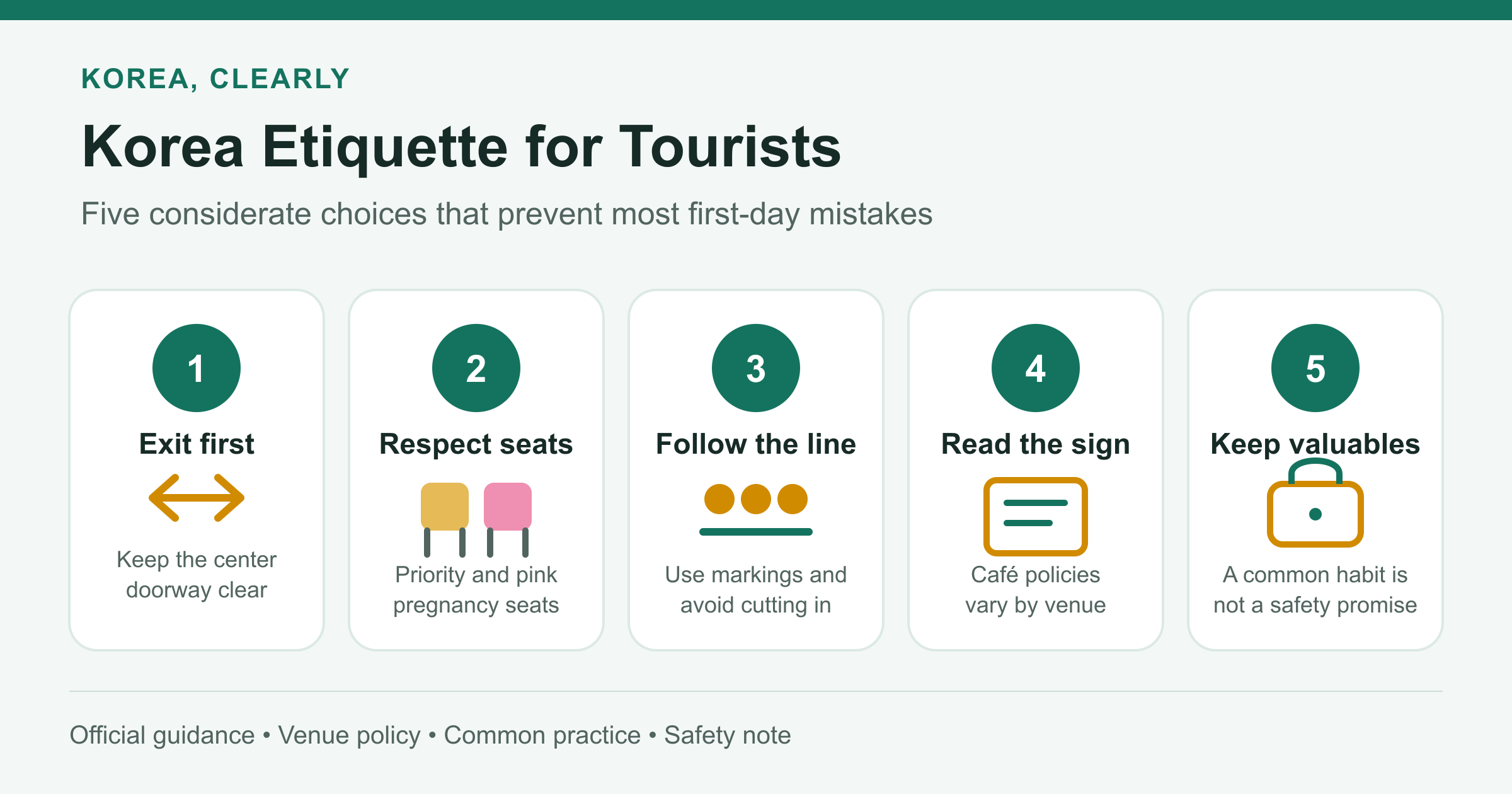
If you remember only five things
- Let passengers exit before you board a subway train or elevator.
- Leave the pink pregnancy seat available unless you are pregnant.
- Do not judge someone using a priority seat. Disability, illness and pregnancy may not be visible.
- Check café signs before sitting or ordering. “One drink per person” and tray-return rules are venue policies, not national laws.
- Keep your passport, wallet, phone and laptop with you even if you see other customers leave belongings on a table.
Rule, custom or store policy?
Many confusing moments come from treating every local habit as a rule. This guide uses four labels:
| Label | What it means | Example |
|---|---|---|
| Official guidance | Published by a public body or transport operator | Let subway passengers exit first |
| Venue policy | Set by an individual café, restaurant or attraction | One drink per seated customer |
| Common practice | Often observed, but neither universal nor enforceable | Holding a café seat with a bag or book |
| Safety note | The cautious choice even when local behavior looks relaxed | Keep passports and valuables with you |
Subway etiquette: seats, lines and luggage
- Wait at the platform markings and keep the center clear. Official guidance. Queue beside the door position shown on the floor or platform screen door. When the train arrives, step back enough to make a clear path.
- Let everyone get off before getting on. Official guidance. Trying to squeeze in early slows the whole exchange. Board one by one after the center path is clear.
- Know what the end-of-car priority area means. Official guidance. These seats are not only for older passengers. They serve people with disabilities, injuries or illnesses, pregnant passengers, adults traveling with infants and others with reduced mobility. Seat colors and symbols can vary by operator, so read the sign.
- Treat the pink seat as a pregnancy seat. Official guidance. Seoul uses pink seats for pregnant passengers, including people in early pregnancy who may not look pregnant. The considerate default is to leave the seat available.
- Do not police another passenger’s body. Safety and courtesy note. A person may have a non-visible disability, illness or early pregnancy. Offer a seat when appropriate, but do not demand proof or confront someone.
- Wear a large backpack in front or put it down. Official guidance. This keeps it from hitting people when you turn. Keep suitcases beside you without blocking the aisle, doors or wheelchair space.
- Use earphones and keep calls brief and quiet. Official guidance plus common courtesy. Seoul’s current campaign asks riders to use earphones for video, music and calls. Keeping a necessary call short and quiet is the considerate way to avoid broadcasting sound through the carriage.
- Move away from the doorway when space is available. Common courtesy. If you must stand near the door, step out temporarily to let others leave, then re-enter without pushing ahead of the queue.
- Do not treat one side of the escalator as a walking lane. Official safety guidance. Stand in two lines where possible, stay inside the yellow line, hold the handrail, and do not walk or run. Follow any on-site direction during crowd control.
- Give elevator priority to people who need it most. Accessibility courtesy. Let riders exit first, then allow wheelchair users, people with strollers, older adults, pregnant passengers and injured travelers to board before passengers who can comfortably use another route.
Want the seat symbols and boarding flow in more detail? Continue with our Korea subway etiquette guide. If you are still planning your arrival, compare how to get from Incheon Airport to Myeongdong or use the direct Incheon Airport to Hongdae route guide.
Bus etiquette and practical rules
- Usually board at the front and exit at the rear. Official guidance for Seoul buses. Press the stop button before your stop. Wheelchair boarding or a driver’s instruction can change which door is used, so avoid treating the pattern as absolute.
- Tap your transport card when you board and when you get off. Official fare rule. The exit tap calculates the correct fare and is needed for transfer discounts. On a bus, tell the driver before tapping if one card will pay for several people; each subway rider normally needs a separate card.
- Do not board a Seoul city bus with a spill-prone drink or open food. Official Seoul rule. A driver may refuse items such as a takeaway cup that can spill. A sealed bottle or properly closable tumbler is generally allowed. Rules outside Seoul can differ.
If you are still choosing the card itself, compare purchase, top-up and gate use in the T-money vs Climate Card guide for foreign cards.
Easy airport mistake: finish or safely pack an open coffee before joining the city-bus queue. A plastic lid with a straw does not make a cup spill-proof under Seoul’s guidance.
Korea café etiquette
- Check whether this café expects “seat first” or “order first.” Venue policy. There is no nationwide sequence. Look for a host, queue, kiosk or sign, and follow what customers immediately ahead of you are doing.
- A bag or book on a table usually means the seat is occupied. Common practice. You may see customers hold a table while ordering, but it is still their table. Do not move the item or take the seat.
- Do not copy the riskiest version of seat-saving. Safety note. Use a low-value item or have one person remain at the table. Keep your passport, wallet, phone and laptop with you. A familiar local habit is not insurance against loss or theft.
- Read “1인 1음료” as “one drink per person.” Venue policy. Some cafés require every seated guest to buy a beverage; others may count a dessert or have no such rule. Ask rather than assuming.
- Return cups and trays when a return station is provided. Venue policy and common courtesy. Look for 반납 or 퇴식구. Separate leftover liquid and waste only as the labels direct.
- Be considerate with time, outlets and large tables. Common courtesy. Laptop use is common in many cafés, but a small busy venue may limit seating time, charging, equipment or table size. Posted rules are more useful than a universal “Korean café rule.”
Our separate Korea café etiquette guide explains kiosks, pagers, pickup counters, seat-saving and useful Korean signs step by step. For a shopping stop nearby, see the Olive Young Central Myeongdong Town shopping guide.
Restaurants, payment and tipping
- Do not add a tip by default. Established convention. Tipping is generally neither required nor expected at Korean restaurants and cafés. Pay the displayed amount unless a clearly disclosed service, hotel or tour policy says otherwise.
- Look around the table before calling a server. Common operating practice. Many restaurants have a call button, utensil drawer or self-service area for water and side dishes. Payment may be at the counter rather than at the table. Follow the setup you can see.
Shoes, trash, toilets and public space
- Remove shoes in a private home and wherever the entrance clearly signals it. Strong convention and venue policy. A raised floor, shoe rack, slippers or posted sign can indicate shoes-off space at a guesthouse, temple or floor-seating restaurant. Ordinary restaurants do not all require it.
- Carry trash until you find the correct bin. Official disposal guidance and practical advice. Public bins exist but may not be close. Use a marked public, venue or accommodation bin; do not leave rubbish beside a full bin or place it in a resident’s private container.
- In a public restroom, flush toilet paper—not wet wipes or sanitary products. Official public-restroom guidance. Put other waste in the appropriate bin. In an older or private facility, follow its posted instructions instead of relying on an old nationwide rule.
- Respect signed smoke-free and residential zones. Official and place-specific rules. Seoul bus stops, city plazas and many other public areas are smoke-free; use a marked smoking area. In Bukchon’s Red Zone around Bukchon-ro 11-gil, tourist visits are prohibited from 5:00 p.m. to 10:00 a.m., with a KRW 100,000 fine. During allowed hours, keep voices low and never photograph inside a home through an open door.
What visitors do not need to overthink
Korea is not an etiquette exam, and most people do not expect a short-term visitor to know every social convention. The useful habit is to pause for three seconds: read the sign, watch the queue, leave space for the person with greater need, and ask politely when the system is unclear.
Avoid conclusions such as “Koreans always leave laptops unattended” or “nobody follows the platform arrows.” A visible behavior may be common, unusual, discouraged or simply one person’s choice. This guide focuses on the action least likely to inconvenience someone else.
Useful Korean signs and phrases
| Korean | Meaning | What to do |
|---|---|---|
| 교통약자석 | Priority seating | Keep it available unless you need it |
| 임산부 배려석 | Pregnancy priority seat | Leave it for a pregnant passenger |
| 1인 1음료 | One drink per person | Each seated guest orders as the venue specifies |
| 반납 / 퇴식구 | Return / tray-return station | Return cups, dishes or trays here |
| 외부 음식 반입 금지 | No outside food | Do not bring food from another venue |
| 금연구역 | Non-smoking area | Find a designated smoking zone |
| 여기 앉아도 돼요? | May I sit here? | Useful when a seat’s status is unclear |
| 죄송합니다 | Excuse me / I’m sorry | Useful when passing through a crowd |
Frequently asked questions
Can tourists sit in priority seats in Korea?
A visitor who genuinely needs priority seating may use it. The seats serve people with reduced mobility, not one nationality. If you do not need the seat, the considerate default is to leave it open. Never judge another passenger only by appearance because disability, illness and pregnancy can be invisible.
What is the pink seat on the Seoul subway?
It is a pregnancy priority seat. Seoul highlights it in pink so pregnant passengers—including those in early pregnancy—can identify and use it more easily. It is not simply an extra seat beside the regular row.
Can a pregnant tourist use the pink seat without a Korean badge?
The official guidance reviewed for this article describes the seat by pregnancy, includes early pregnancy and does not state that a Korean badge is required. Our reading is that a pregnant visitor may use it. A badge can make the need more visible, but should not be used to judge another rider.
Should I leave a priority seat empty when the train is quiet?
If you do not need it, leaving it available follows official visitor guidance and avoids having to move when someone boards. If you do need it, use it. Seat signs and operator guidance take priority over assumptions based on another rider’s age or appearance.
How do people line up for the subway in Korea?
Stand along the floor or screen-door queue markings, usually to either side of the door position. Keep the middle open, let passengers exit completely, then board in order. Exact line shapes vary by station, so follow the markings in front of you.
Is it normal to save a café seat with a bag?
You may see customers use a bag, coat or book to show that a table is occupied while they order. That is a common practice, not a right or a safety promise. Check the café’s flow, avoid holding a table for a long absence and keep valuables with you.
Does every Korean café require one drink per person?
No. It is a venue policy. Look for “1인 1음료,” read the English notice if available, or ask staff whether a dessert counts. Do not assume that a rule seen at one popular café applies to the next one.
Do tourists need to tip in Korea?
Generally no. Tipping is neither required nor expected at ordinary restaurants and cafés. Pay the stated amount. A private guide, hotel or special service can have its own clearly disclosed arrangement, so check that service rather than importing a restaurant rule from home.
When should I remove my shoes?
Always remove them when entering a private home. At guesthouses, temples and restaurants, look for a raised floor, a row of shoes, a shoe cabinet, slippers or a sign. Keep them on in an ordinary space unless the entrance setup tells you otherwise.
Official sources
- Korean Law Information Center: definition of transport-vulnerable passengers
- Visit Seoul: Public Transportation Etiquette in Korea, edited December 3, 2025
- Ministry of the Interior and Safety: escalator safety guidance and 2026 two-line direction
- Seoul Metropolitan Government: foods and drinks restricted on city buses
- Visit Seoul: The Basics of Korean Etiquette
- Visit Seoul: smoking and public-restroom guidance
- Government of Korea: public-restroom toilet paper guidance
- Seoul Metropolitan Government: Bukchon visitor restrictions
- Visit Seoul: respectful behavior in Bukchon Hanok Village
- Visit Seoul: Lost and Found, LOST112 and traveler assistance
Update history: first fully verified edition prepared July 21, 2026. This guide separates official rules from editorial observations and is not affiliated with Seoul Metro, a café chain or a tourism operator.