KTX Station Name Traps: Seoul, Gyeongju, Busan & More

The short answer: never book a Korean train from the city name alone. Check the exact English station name, Korean station name and map pin before payment. The most important traps are Seoul Station versus Yongsan, Gyeongju versus its former name Singyeongju, Gwangju-Songjeong versus Gwangju Station, Osong versus Cheongju, and Busan Station versus Gupo or Bujeon.
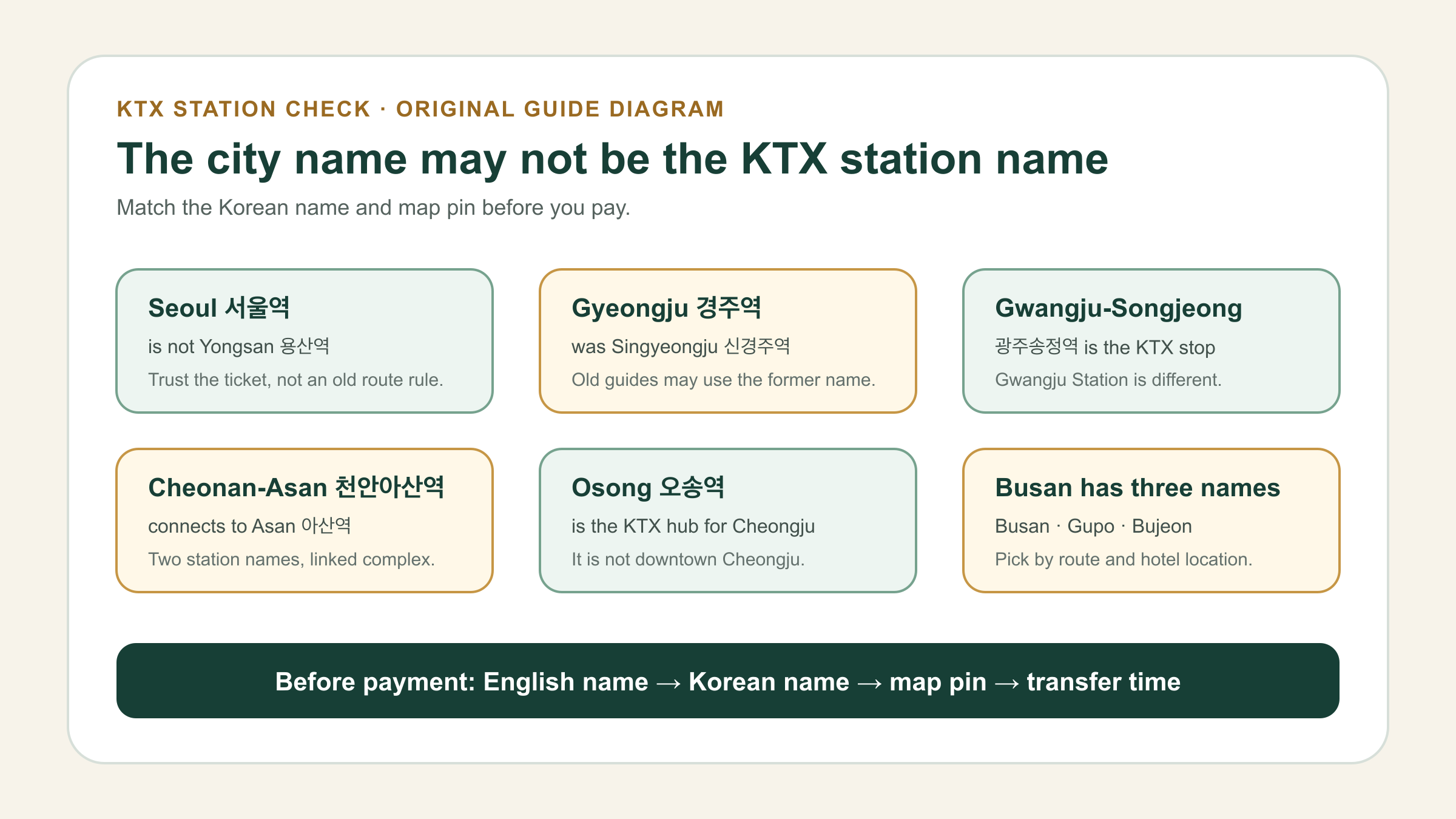
KTX station name warning guide

Checked July 21, 2026

This guide uses KORAIL’s timetable page, current local-government transport information and VisitKorea station guidance. KORAIL’s latest timetable posted at review time took effect May 15, 2026. Not every train stops at every station, and schedules differ by train number and day, so the station printed on your live search result and ticket is final.

The station check to do before every KTX payment

  1. Read the full English name: “Gwangju-Songjeong” is not the same result as “Gwangju.”
  2. Match the Korean name: copy the Hangul from this guide into KORAIL or your map app.
  3. Open the exact map pin: compare the station with your hotel or first attraction.
  4. Count the local transfer: a station outside the center may erase the time saved by KTX.
  5. Return to the ticket: confirm departure station, arrival station, date and time one last time.
Travel plan Station to verify Do not confuse it with Map
Long-distance train from central Seoul Seoul 서울역 or Yongsan 용산역 They are separate terminals Compare the two stations
KTX station outside southwest Seoul Gwangmyeong 광명역 Gwangmyeongsageori 광명사거리역 Open Gwangmyeong Station
Historic Gyeongju Gyeongju 경주역 Old guides calling it Singyeongju; the former downtown station Open Gyeongju Station
KTX to Gwangju Gwangju-Songjeong 광주송정역 Gwangju 광주역 Open Gwangju-Songjeong
KTX for Cheonan/Asan Cheonan-Asan 천안아산역 Asan 아산역 or Cheonan 천안역 Open Cheonan-Asan
KTX in Daejeon Daejeon 대전역 or selected Seodaejeon 서대전역 trains They are not interchangeable Compare the two stations
KTX for Cheongju Osong 오송역 Cheongju 청주역 or Cheongju Airport 청주공항역 Open Osong Station
Train to Busan Busan 부산역, Gupo 구포역 or Bujeon 부전역 Three different terminals Open Busan Station

1. Seoul Station vs Yongsan Station

Seoul Station is 서울역. Yongsan Station is 용산역. They are separate large terminals linked by Seoul Subway Line 1, not two entrances to the same station.

VisitKorea describes Seoul Station as the representative starting point for the Gyeongbu and Gangneung lines and Yongsan as the representative start of the Honam line. That is a useful orientation, but it is not a safe booking rule. KORAIL removed the strict regional-terminal division years ago, and a Honam-line train can use Seoul Station or Yongsan depending on the service. Do not decide “Busan equals Seoul” or “Gwangju equals Yongsan” without reading the actual train result.

Ticket rule: if the ticket says 서울역, go to Seoul Station. If it says 용산역, go to Yongsan Station. A taxi driver cannot fix a reservation for the other terminal, and crossing central Seoul with luggage can make you miss the train.

Open the Seoul Station → Yongsan Station comparison in Google Maps. Google chooses a live route; the KORAIL ticket remains the authority for your boarding station and time.

2. Gwangmyeong Station vs Gwangmyeongsageori Station

Gwangmyeong Station is 광명역, a major KTX station in Gwangmyeong, Gyeonggi-do. It is not in central Seoul. Gwangmyeongsageori Station is 광명사거리역, a Seoul Subway Line 7 station in a different part of the city. The similar English names are the trap.

Some travelers select Gwangmyeong because a train is available there after Seoul Station sells out. That can work, but count the transfer first. The Line 1 Gwangmyeong shuttle has limited service compared with an ordinary central subway route, and not every KTX stops at Gwangmyeong. Confirm both the local trip to 광명역 and the long-distance train number.

Open the exact Gwangmyeong KTX Station pin. If a map result says 광명사거리역, it is the wrong station.

3. Gyeongju Station is the former Singyeongju Station

The current KTX station is Gyeongju Station, 경주역. It was called Singyeongju Station, 신경주역 until December 2023. KORAIL’s station record gives the official name-change date as December 26, while some public announcements and systems completed the visible change around December 28. Either old or new English text can therefore appear in an older article or saved map, but they refer to the same modern KTX station at 80 Gyeongjuyeok-ro, Geoncheon-eup.

The more dangerous confusion is the former downtown Gyeongju Station. That old passenger station closed after rail relocation in December 2021. Do not navigate to the old downtown site to catch KTX. The active KTX station is outside the historic center, so add a bus or taxi transfer to Hwangnidan-gil, Daereungwon or your hotel.

Search phrase to copy: 경주역 KTX. If an old guide says “Singyeongju,” confirm that its pin matches the current KTX station—not the former downtown station.

Open Gyeongju Station → Hwangnidan-gil in Google Maps. Verify the live local route and official bus information on travel day.

For the airport connection, KTX booking and current downtown handoff in one sequence, use the complete Incheon or Seoul to Gyeongju guide.

4. Gwangju-Songjeong Station vs Gwangju Station

For a KTX trip to Gwangju, search Gwangju-Songjeong Station, 광주송정역. Gwangju’s 2026 official KTX timetable lists 광주송정역, not Gwangju Station, 광주역. The latter is a separate conventional-rail station in Buk-gu.

Gwangju-Songjeong is west of the central sightseeing districts. After arrival, use Gwangju Metro Line 1, a bus or a taxi for the Asia Culture Center, Chungjang-ro, U-Square terminal or your accommodation. Booking the correct KTX station does not mean the attraction is beside the platform.

Open the exact Gwangju-Songjeong pin. Show a driver 광주송정역, not only “Gwangju Station.”

5. Cheonan-Asan, Asan and Cheonan are three names

Cheonan-Asan Station, 천안아산역, is the high-speed KTX/SRT station. Asan Station, 아산역, serves Seoul Subway Line 1 and conventional Janghang Line trains. The buildings are connected by an indoor passage, which makes the pair convenient but does not make the names interchangeable on a ticket.

Cheonan Station, 천안역, is another conventional-rail and Line 1 station in central Cheonan. It is not the normal KTX stop. If you transfer between KTX and Line 1 at the connected complex, follow signs from 천안아산역 to 아산역 and allow time to reach the correct platform.

Open Cheonan-Asan KTX Station.

6. Daejeon Station vs Seodaejeon Station

Daejeon Station, 대전역, is the main Gyeongbu-line KTX station and a central city hub. Seodaejeon Station, 서대전역, is a separate Honam-line station used by selected Honam and Jeolla KTX services. Many south-western high-speed trains use the high-speed route via Gongju and do not stop at Seodaejeon.

There is a second naming trap: Seodaejeon Negeori Station, 서대전네거리역, is a Daejeon Metro station and is not the same place as the Korail terminal. Read all characters on the map result.

Compare Daejeon and Seodaejeon in Google Maps.

7. Osong is the KTX station for the Cheongju area

Osong Station, 오송역, is the KTX hub within Cheongju’s administrative area. It is west of central Cheongju, so it should not be treated as a downtown station. Cheongju Station, 청주역, and Cheongju Airport Station, 청주공항역, are separate conventional Chungbuk Line stations.

If you are flying through Cheongju International Airport, VisitKorea directs travelers to the nearby rail and bus links rather than pretending the KTX platform is at the terminal. Its June 2026 guide lists buses such as B3 and 747 between the airport area and Osong. Check the current departure point and timetable locally.

Correct KTX search: use 오송역 for a high-speed train to the Cheongju area. Use 청주역 or 청주공항역 only when the conventional train route is the journey you actually want.

8. Busan Station, Gupo and Bujeon serve different trips

Busan Station, 부산역, is the representative terminus for the high-speed Gyeongbu KTX from Seoul and is convenient for the port, Nampo and transfers on Busan Metro Line 1. Gupo Station, 구포역, is in western Busan and is served by selected trains using the older Gyeongbu route. Not every Busan-bound KTX stops there.

Bujeon Station, 부전역, is near Seomyeon in Busanjin-gu and serves a different rail pattern. Busan reported a major expansion from December 30, 2025: Central Line KTX-Eum between Cheongnyangni and Bujeon increased, and Donghae Line KTX-Eum connected Bujeon and Gangneung. That does not make Bujeon an interchangeable replacement for a Seoul Station–Busan Station Gyeongbu KTX.

Choose by both route and hotel location. A Gupo stop may help a west-Busan stay; Bujeon may suit a Central or East Coast route; Busan Station is often simplest for the classic Seoul–Busan high-speed trip. The exact train result decides which option is available.

If Busan Station is the correct arrival, continue with the complete airport/Seoul to Busan guide for the KTX connection and local route to Nampo, Seomyeon or Haeundae.

9. Incheon Airport has AREX, not a direct KTX

There is no current direct KTX departure from Incheon Airport Terminal 1 or Terminal 2. The airport KTX service ended in 2018. The train branded AREX Express at the airport is the Airport Railroad, not KTX.

For most visitors, the clearest rail connection is AREX to Seoul Station, then KTX from the station printed on the reservation. Another option is the 6770 KTX Airport Limousine Bus to Gwangmyeong Station. Google Maps can display a live route, but it currently warns that some regional schedule data may not be up to date; confirm the official airport and KORAIL timetable before committing to a connection.

This route opens with both endpoints and transit mode filled in. Google may select a different live option by departure time.

At Seoul Station, allow time between the deep AREX platforms and the KTX concourse, especially with luggage or an elevator wait. Do not book the next long-distance train based on the scheduled AREX arrival minute alone.

A safer station-name workflow for your itinerary

  1. Search the long-distance train on the official KORAIL English page.
  2. Copy the selected station in Korean into your trip note.
  3. Open the map pin and save it. Add your hotel as the other endpoint to see the local transfer.
  4. Send the Korean station name to everyone in the group; do not share only “Seoul” or “Gwangju.”
  5. On travel day, compare the ticket with the station sign before entering the concourse.

For the full payment and ticket-retrieval process, use How to Book KTX Tickets as a Foreigner.

Frequently asked questions

Are Seoul Station and Yongsan Station interchangeable?

No. They are separate terminals. Both can serve long-distance trains, so use the exact station printed on your chosen result and ticket.

Is Singyeongju a different station from Gyeongju?

No. The active KTX station formerly called Singyeongju was renamed Gyeongju in December 2023. The old downtown Gyeongju passenger station is closed.

Which station should I book for KTX to Gwangju?

Use Gwangju-Songjeong Station, 광주송정역. Gwangju Station, 광주역, is a different conventional-rail station.

Which KTX station serves Cheongju?

Use Osong Station, 오송역, for KTX. It is within Cheongju but outside the downtown core. Cheongju Station and Cheongju Airport Station are different conventional stations.

Is there a direct KTX from Incheon Airport?

No current direct KTX leaves Terminal 1 or Terminal 2. AREX to Seoul Station or the 6770 airport bus to Gwangmyeong are common transfer patterns; verify the live operator timetable.

Should I arrive at Busan, Gupo or Bujeon?

It depends on the available train route and where you are staying. Busan Station is the usual terminus for the classic Gyeongbu KTX, Gupo serves selected west-Busan trains, and Bujeon is important for Central and East Coast KTX-Eum routes.

Official and public-agency sources

Update history: first verified edition prepared July 21, 2026. Google Maps routes were opened with both endpoints and transit mode during review. Maps may not carry the latest rail or bus schedule; KORAIL, the airport and the station display remain authoritative.

Scroll to Top