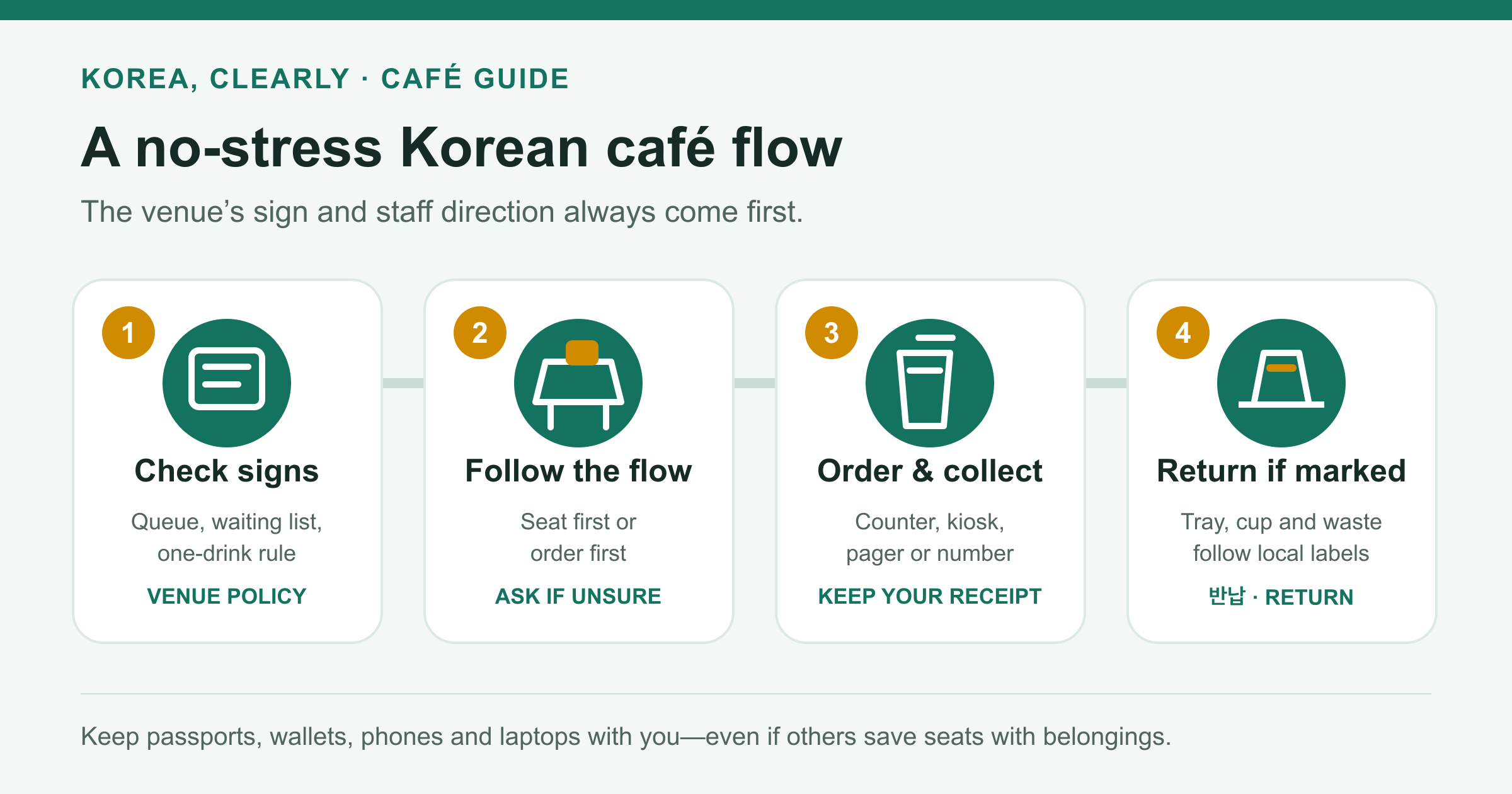
The safest café routine in Korea is: read the entrance sign, check whether the venue wants you to order or find a seat first, keep valuables with you, order according to any “one drink per person” notice, and return your tray if a return station is provided.
Checked July 21, 2026
Korea has no single national café-etiquette code. This guide separates common habits from individual venue policies and safety advice. The sign in front of you and a staff instruction always override a general tip.
Korea café etiquette in 30 seconds
| Question | Safest answer | Type |
|---|---|---|
| Seat first or order first? | Follow the sign, host, kiosk or queue; either system is possible | Venue policy |
| Bag on an empty chair? | Treat the seat as occupied; do not move the item | Common practice |
| Can I hold my own seat with a bag? | Sometimes, but use a low-value item or leave one person at the table | Common practice + safety note |
| One drink per person? | Only when the venue states it; check whether dessert counts | Venue policy |
| Leave the tray? | Return it if a marked return station exists | Venue policy + courtesy |
| Tip? | Not normally required or expected | Established convention |
Step 1: check the café’s flow before choosing a table
Korean cafés use several different systems. A large self-service chain may let you choose any open table, a popular dessert café may operate a waiting list, and a small specialty shop may ask you to order before sitting. Do not assume that one system is “the Korean way.”
Look for these clues
- A host or tablet at the entrance: join the waiting list or speak to staff before sitting.
- A clear counter queue: order first unless a sign asks you to secure a seat.
- Customers placing a bag, then ordering: finding a seat first may be the normal flow at that venue.
- A kiosk: check whether it asks for dine-in or takeaway and whether it prints a number.
- A time-limit sign: read it before paying, especially at a small or highly photographed café.
If you are unsure, show the table area and ask “먼저 앉아도 돼요?” (Meonjeo anjado dwaeyo? — May I sit first?). A gesture plus the simple question is usually enough.
Popular cafés can have several branches with similar English names. Before traveling across the city, use the Korean address and NAVER Map workflow to confirm the branch, floor and entrance.
Step 2: understand seat-saving without risking valuables
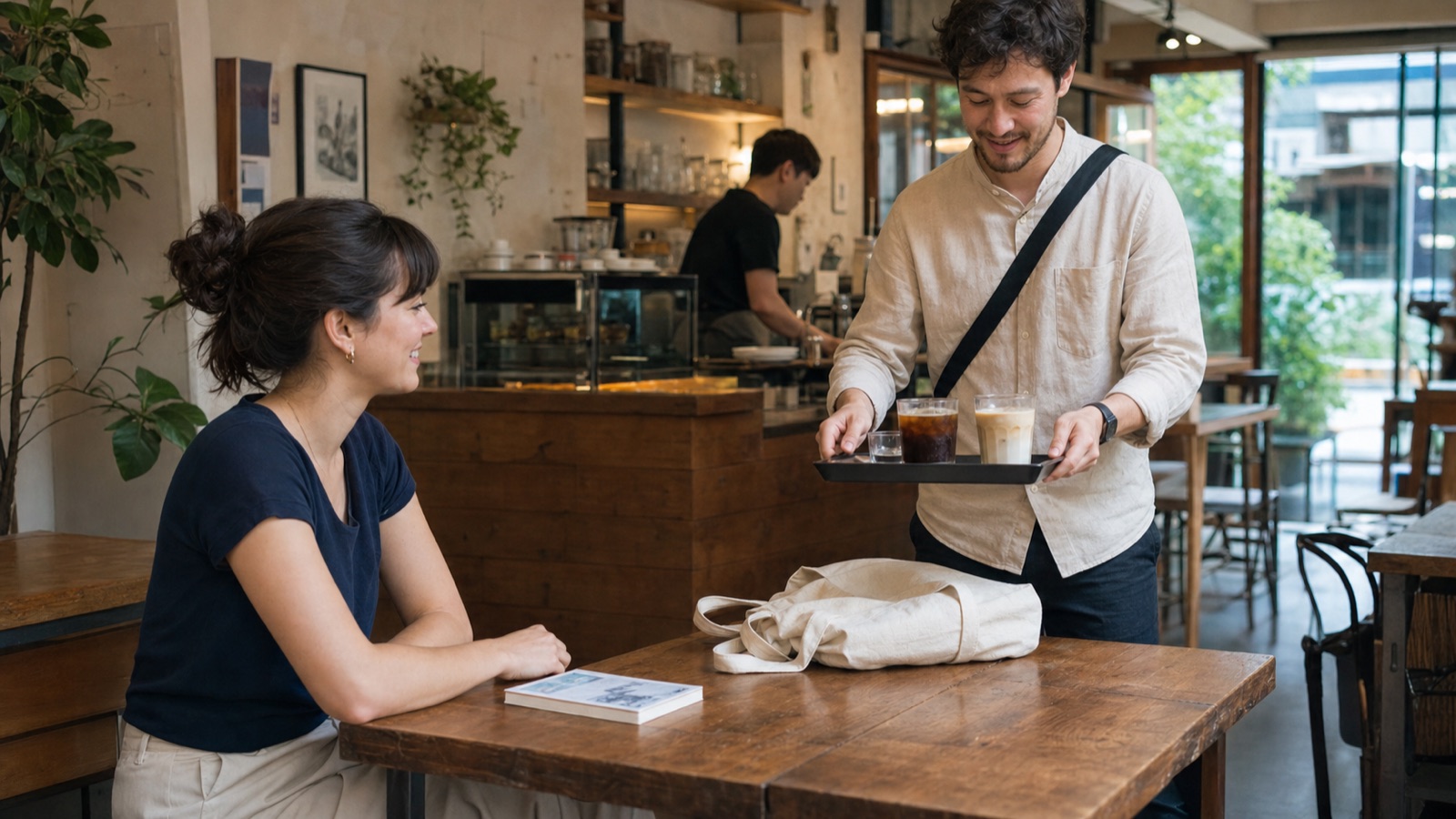
You may see a coat, bag, book or even an electronic device left on a table while its owner orders. The item usually communicates “this seat is occupied.” Do not move it or sit there simply because nobody is physically present.
That visible habit is not a promise that theft or loss cannot happen. Korea’s official tourist information describes Seoul as generally safe, but official services also provide theft reporting and lost-property systems for a reason.
A safer way to hold a seat
- If you are with someone, have one person stay at the table.
- If the venue’s flow clearly allows seat-saving, use a low-value item such as a folded umbrella or ordinary tote.
- Keep your passport, wallet, phone, camera and laptop with you.
- Do not leave a table unattended for a long time, especially when the café is busy.
How to ask whether a seat is free
Point politely and ask “여기 앉아도 돼요?” (Yeogi anjado dwaeyo? — May I sit here?). If the table holds a drink, charger, bag or coat, assume it is occupied until someone confirms otherwise.
Step 3: read the one-drink rule correctly
1인 1음료 means one drink per person. It is a venue policy, not Korean law and not a universal rule. At a café displaying it, every person using a seat usually needs to order a beverage.
Do not assume that cake replaces a drink. Some venues count a dessert toward the minimum; others specifically require a beverage. Children may have a different policy. If the sign is unclear, ask before ordering:
“디저트도 괜찮아요?”
Dijeoteudo gwaenchanayo?
Does dessert count?
A simple alternative is to show the sign and ask “사람마다 음료를 주문해야 해요?” (Saram-mada eumnyoreul jumunhaeya haeyo? — Does each person need to order a drink?).
Step 4: order, pay and collect
Self-service is common, but not universal. A typical sequence is:
- Order and pay at the counter or kiosk.
- Choose 매장 (dine in) or 포장 (takeaway) when asked.
- Keep the receipt, number card or vibrating pager.
- Collect the drink when the number is called, shown on a screen or the pager vibrates.
- Take straws, water or napkins only from the marked self-service area.
Card payment is common, but a foreign card can occasionally fail at a kiosk. Try the staffed counter or a second card rather than repeatedly blocking the kiosk queue. If you have an allergy, do not rely only on a menu photo; confirm ingredients with staff.
Useful ordering phrases
| Korean | Pronunciation | Meaning |
|---|---|---|
| 매장에서 먹고 갈게요 | Maejang-eseo meokgo galgeyo | For here, please |
| 포장해 주세요 | Pojanghae juseyo | To go, please |
| 이거 하나 주세요 | Igeo hana juseyo | One of this, please |
| 디카페인 있어요? | Dikapein isseoyo? | Do you have decaf? |
| 반납하는 곳이 어디예요? | Bannaphaneun gosi eodiyeyo? | Where is the return station? |
Step 5: return the tray when the café is self-service
Look for 반납 (return) or 퇴식구 (tray-return station). At a self-service café, carry your cup, dish and tray there when finished. Some stations ask customers to pour leftover liquid into one opening and sort cup sleeves, lids or general waste into separate containers.
Follow the labels rather than inventing your own recycling system. If staff served the table and there is no return area, leaving the dishes neatly on the table may be correct.
Laptops, outlets and long stays
Working or studying in a café is common, but it does not create an unlimited right to space or electricity. A venue may restrict laptops, charging, large equipment, table use or seating time—particularly during peak hours.
- Use a small table when alone instead of occupying a table for four.
- Keep charging cables inside your space so nobody trips.
- Use earphones for meetings and avoid speakerphone calls.
- Order again or leave when you have stayed a long time in a busy venue.
- Take your belongings if you will be away for more than a brief restroom or ordering trip.
These are considerate defaults, not a fixed hourly rule. A study-friendly chain and a twelve-seat dessert café may reasonably expect different behavior.
Outside food, pets and photography
These are all venue policies. Look for signs rather than assuming:
- 외부 음식 반입 금지: no outside food.
- 반려동물 동반 가능: pets allowed; restrictions can still apply.
- 노키즈존: no-kids zone; age definitions can vary.
- 촬영 금지: no photography or filming.
Even in a photo-friendly café, avoid photographing another customer’s face, laptop screen or conversation. Ask before moving chairs, products or decorations for a shot, and do not block the counter or staircase.
Do you tip in Korean cafés?
No tip is normally required or expected. Pay the amount shown on the menu or terminal. If a jar, app or special service explicitly offers an optional gratuity, you can decide, but do not feel obliged to leave cash on an ordinary café table.
Common mistakes
- Moving a bag from an “empty” chair: the seat is probably occupied.
- Leaving a passport or phone to copy local seat-saving: common behavior is not a security guarantee.
- Assuming every café is seat-first: some use a host, queue or waiting app.
- Treating “one drink per person” as national law: it is a venue rule.
- Assuming dessert always counts: ask the specific café.
- Leaving a tray in a self-service venue: look for the return station.
- Taking a long call on speaker: use earphones and keep your voice low.
- Photographing strangers or private screens: frame the café, not another customer’s personal space.
Frequently asked questions
Should I find a seat before ordering in a Korean café?
Sometimes, but not always. Read the entrance sign and watch the venue’s queue. A self-service café may allow seat-first, while a popular or small venue may seat customers after ordering or use a waiting list. Ask staff if the flow is unclear.
Is it normal to leave a bag on a café table?
You may see customers use a bag, coat or book to signal that a table is occupied while ordering. Treat the item as an occupied-seat marker, not abandoned property. If you copy the practice, use a low-value item and stay away only briefly.
Is it safe to leave my phone or laptop unattended?
No place can guarantee that. Keep passports, wallets, phones, cameras and computers with you. Korea may feel relaxed about belongings, but loss and theft still happen, and a café habit does not transfer the risk to the venue.
Does every café require one drink per person?
No. Look for “1인 1음료.” If it appears, ask whether dessert counts and whether children are included. A rule at one café does not automatically apply to another.
Can I use a laptop for several hours?
It depends on the venue, crowd and posted policy. Use a suitable table, keep cables tidy, avoid calls on speaker and do not leave your setup unattended. A second order or an earlier departure is considerate when a small café is full.
Do I return my cup and tray?
Yes when there is a marked self-service return station. If the café provides table service and no return area exists, leave the dishes neatly for staff. Follow the system you can see rather than applying one rule everywhere.
Should I tip the barista?
Tipping is generally neither required nor expected in Korean cafés. Pay the displayed total. An explicitly optional jar or app choice is different, but cash left on a normal table can create confusion.
Official and supporting sources
- Visit Seoul: general etiquette and tipping
- Visit Seoul: traveler safety and restaurant precautions
- Visit Seoul: lost property, LOST112 and traveler hotline
- Korea Tourism Organization: Korean restaurant systems and tipping
- Korea Tourism Organization venue listing showing an individual one-drink policy
Update history: first fully verified edition prepared July 21, 2026. Café customs vary by venue; common observations in this article are not presented as law or a safety guarantee.