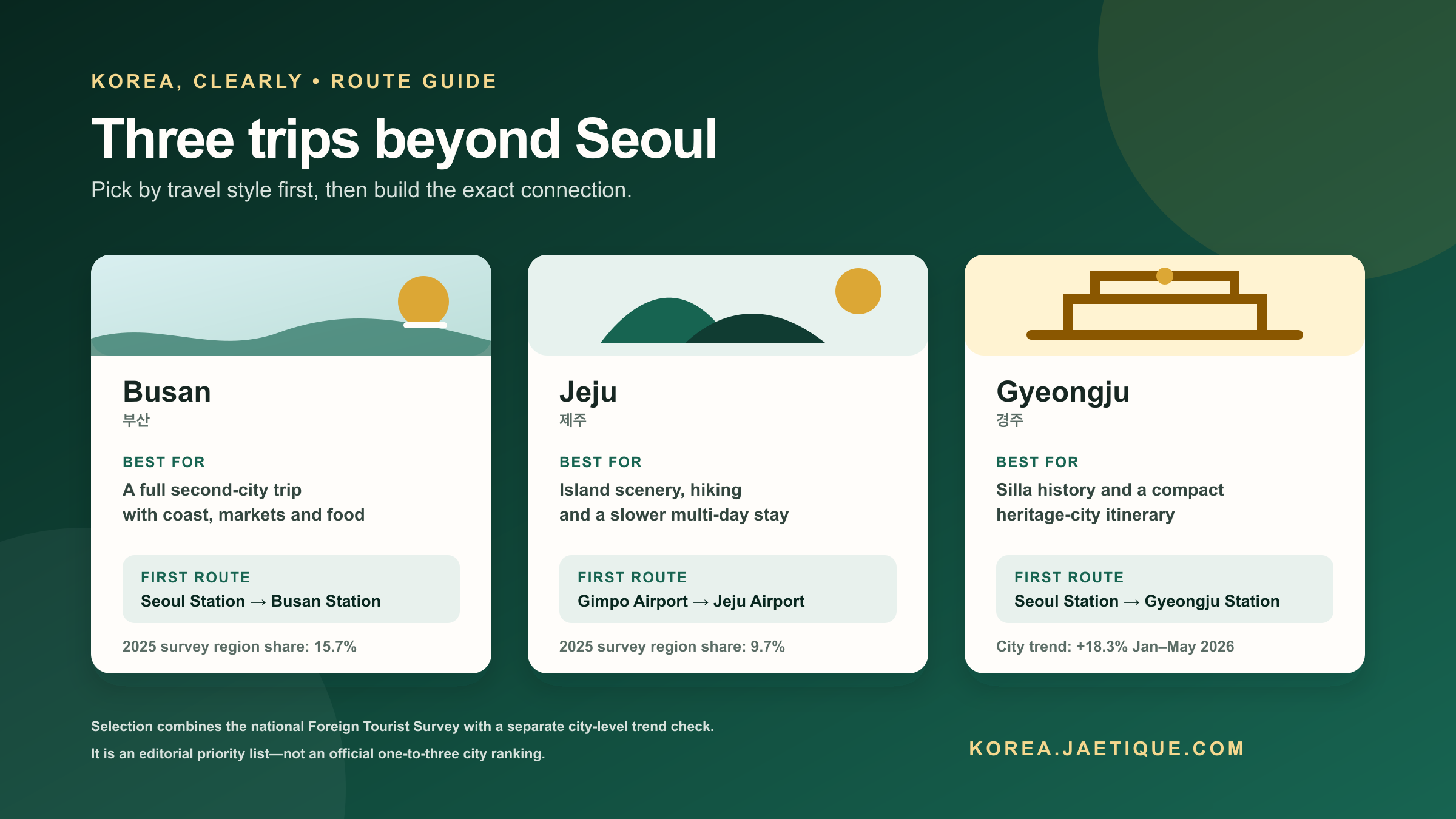
The short answer: for a first trip beyond Seoul, choose Busan for a full second-city experience, Jeju for island landscapes and a slower multi-day trip, or Gyeongju for a compact Silla-history itinerary. These are our three editorial destination priorities—not an official one-to-three league table—because Korea’s national visitor survey reports most results by province or metropolitan region, not by individual city.
If you have not yet decided how much of the trip belongs in Seoul—or whether another region fits at all—start with the complete first-trip destination shortlist. Return here when you are ready to compare the three main additions beyond Seoul in more detail.
Evidence checked July 21, 2026
The finalized 2025 Foreign Tourist Survey found that 32.7% of respondents visited a non-capital region during their trip: 18.3% visited only non-capital areas and 14.4% visited both capital and non-capital areas. In the multiple-response region question, Busan was reported by 15.7% and Jeju by 9.7%. The survey interviewed 16,110 foreign visitors; its reported percentages are weighted estimates. Percentages can add to more than 100% because one traveler could report several regions.
Why these three destinations made the first expansion list
| Destination | Best reason to go | Best first route | Suggested first-trip stay | Selection signal |
|---|---|---|---|---|
| Busan 부산 | Beaches, markets, coastal neighborhoods and a large-city food scene | Direct KTX from Seoul Station to Busan Station | 2–3 nights | Direct national-survey region share: 15.7% |
| Jeju 제주 | Volcanic scenery, coast, hiking and a different pace from mainland cities | Domestic flight from Gimpo Airport to Jeju Airport | 3–4 nights | Direct national-survey region share: 9.7% |
| Gyeongju 경주 | Silla history, royal tombs and major heritage sites in one compact destination | KTX from Seoul Station to Gyeongju Station, then bus or taxi downtown | 1–2 nights | Largest 2025 Data Lab estimate among the three lower-level candidates screened; +18.3% year on year in Jan–May 2026 |
These signals are context, not a like-for-like ranking. The Busan and Jeju percentages come from the same national survey and can be compared as region-level multiple responses. Gyeongju is inside Gyeongsangbuk-do and does not have its own row in that survey. From January through May 2026, Gyeongju recorded a population-expanded total of 569,357 daily unique foreign visits, up 18.3% year on year. The total is built by summing each day’s estimate: one person can be counted again on another day, so it is neither a unique-tourist nor a trip total, and visit purpose is unknown. Korea Tourism Data Lab recommends using this mobile-location measure for trends rather than as an absolute headcount.
As a secondary screen, we also checked the same 2025 Tourism Data Lab definition across Busan, Jeju, Gyeongju, Jeonju and Gangneung. Busan and Jeju formed the large upper tier, while Gyeongju was ahead of Jeonju and Gangneung, the other lower-level candidates screened here. That comparison still has an administrative-boundary limitation—Busan and Jeju are larger upper-level regions—so the figures remain an editorial screening tool rather than public-facing tourist totals.
Choose Busan if you want a true second-city trip
Busan works best when you want another major city rather than a day excursion from Seoul. It has distinct lodging zones, an urban metro, beaches, a working port and enough neighborhoods to fill several days. The classic arrival point is Busan Station, 부산역, on the Gyeongbu KTX corridor. From there, Busan Metro Line 1 runs toward Nampo and Jagalchi in one direction and Seomyeon in the other. Haeundae and Gwangalli require a longer local transfer.
Busan is also the easiest of the three to add after Seoul without flying. A direct train removes airport check-in, baggage limits and a cross-city airport transfer. The main planning mistake is assuming that every place with “Busan” in its name is near Busan Station: Gimhae Airport, Haeundae, Gupo Station, Bujeon Station and Busan Station serve different parts of the metropolitan area.
Use the complete route guide: How to Get to Busan from Incheon Airport or Seoul.
Choose Jeju if the island is part of the trip—not a spare afternoon
Jeju is a province and an island as well as the name travelers use for the destination. Jeju City, 제주시, is on the north side near the airport; Seogwipo, 서귀포시, is the main southern city. A hotel described only as “Jeju” can therefore be far from the attraction you saved.
There is no KTX to Jeju. From Seoul, most visitors fly from Gimpo Airport Domestic Terminal, 김포공항 국내선. If you land internationally at Incheon and hold a separate Jeju ticket, you must enter Korea, collect baggage, travel overland to Gimpo and check in again. That self-transfer is not protected just because both airports are in the Seoul region.
Use the complete route guide: How to Get to Jeju from Incheon Airport or Seoul.
Choose Gyeongju if history is your strongest travel motive
Gyeongju offers the clearest contrast with modern Seoul in a short stay. Hwangnidan-gil, Daereungwon, Cheomseongdae and Donggung Palace and Wolji Pond can form a practical central route, while Bulguksa and the Bomun area need additional transport. It can be a long day trip, but one overnight gives the city a much better rhythm.
The critical trap is the station. The active high-speed station is Gyeongju Station, 경주역, outside the historic center. It was called Singyeongju Station, 신경주역 until late 2023. The former downtown passenger station closed in 2021, so an old map or hotel blog can send you to the wrong place.
Use the complete route guide: How to Get to Gyeongju from Incheon Airport or Seoul.
Which city fits your itinerary?
You have only one night
Choose Gyeongju only if history is a priority and your train times allow a calm afternoon and evening. Busan deserves at least two nights, while Jeju usually loses too much value to airport transfers for a one-night detour.
You have two or three nights
Busan is the most versatile first choice. Two nights can cover one coastal zone and one central-market zone; three nights reduce the pressure created by long local travel between them. Gyeongju can also work for two nights, especially when paired with Busan.
You have four or more nights
Jeju becomes much more attractive. Weather can change hiking or coastal plans, and attractions are spread across the island. Extra time lets you choose one base carefully or split nights between Jeju City and Seogwipo instead of crossing the island every day.
You are arriving from an overnight international flight
Do not force a tight onward connection. Busan and Gyeongju require a separate airport-to-rail transfer; Jeju requires immigration, baggage collection, an airport-to-airport journey and a new domestic check-in when tickets are separate. A Seoul arrival night can be the safer, more enjoyable choice.
Build the route before buying nonrefundable tickets
- Choose the exact lodging zone. “Busan,” “Jeju” or “Gyeongju” is not precise enough for a transport decision.
- Save the Korean name and address. Use the Korean-address map workflow when English search produces ambiguous pins.
- Price the complete trip. Include the airport or station transfer, baggage fees, seat choice and the last local leg.
- Verify the live operator. KORAIL controls train availability; the airline controls check-in and baggage; the local transport operator controls the final bus or metro.
- Leave a disruption buffer. Separate tickets do not create a protected connection.
If Busan or Gyeongju is next, compare the foreigner KTX booking flow with the express and intercity bus booking flow, then check the Korean station-name traps. For local buses and metros after arrival, confirm whether your existing T-money setup works for the trip.
Frequently asked questions
Are these officially the three most-visited destinations outside Seoul?
No. Korea’s national survey publishes most destination results by metropolitan city or province. Busan and Jeju have comparable national-survey shares; Gyeongju is an editorial third choice supported by a separate city-level growth indicator, a compact heritage itinerary and practical KTX access.
Can I visit Busan as a day trip from Seoul?
It is physically possible by KTX, but the round trip consumes valuable time and Busan’s main districts are spread out. At least two nights is a better first-visit plan.
Can I take KTX to Jeju?
No. Jeju is an island. Most Seoul-based visitors fly from Gimpo Airport; ferries serve selected mainland ports and are a different itinerary.
Is Gyeongju a realistic day trip?
Yes, if you take an early KTX and focus on the central historic area. Add the station-to-center transfer and the final return bus or taxi to your schedule. One overnight is less rushed.
Should I buy every ticket before arriving in Korea?
Book scarce KTX seats and domestic flights early when your dates are firm, but avoid a tight nonrefundable connection after an international arrival. Keep the first onward segment changeable when possible.
Sources and definitions
- Korea Tourism Organization: 2025 Foreign Tourist Survey, finalized
- Gyeongju City: January–May 2026 foreign-visit trend
- Korea Tourism Data Lab: visitor-data definitions and limitations
- KORAIL: English train reservation
Turn the Busan choice into a workable plan
Update history: first verified edition prepared July 21, 2026. Destination evidence is refreshed when the annual Foreign Tourist Survey is finalized; route articles are checked monthly.