The short answer: the best things to buy in Korea are items you will actually use, can verify in person and can pack without creating a customs problem. Start with K-beauty you have tested, sealed food gifts, lightweight Korean craft or museum-shop goods, and official music or character merchandise. Skip a viral haul when you do not know the shade, ingredients, voltage, import rule or final suitcase weight.
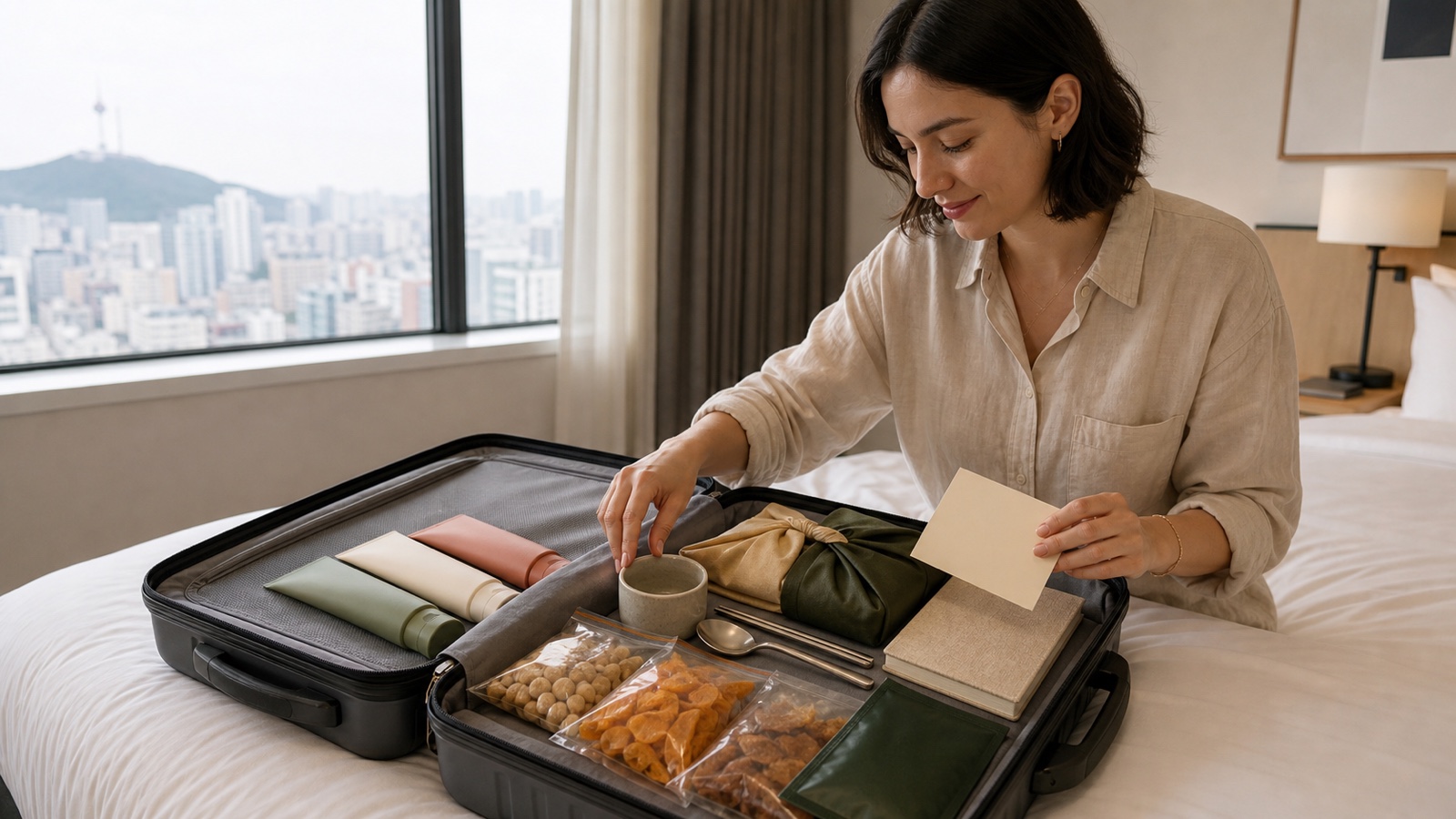
Shopping and packing details checked July 22, 2026
Recommendations were checked against the 2025 Foreign Tourist Survey, Korea Tourism Organization shopping guidance, Korea Customs Service, Incheon Airport and current official arrival rules for the United States, Great Britain, Australia and Canada. Product availability, prices, airline rules and destination-country import rules can change.
Why shopping deserves a plan: the finalized 2025 Foreign Tourist Survey found that 80.3% of surveyed foreign visitors reported shopping in Korea. Among visitors who reported shopping expenditure, 71.3% bought perfume or cosmetics; that is not 71.3% of every visitor. The same survey shows beauty is important, but it does not mean every trending product is right for you.
What to buy in Korea: the useful shopping list
If you want the compact version, begin with one item from each row that matches your interests. The list below favors portability, everyday use and a clear connection to Korea over novelty alone.
| Category | Best first choices | Why they travel well | Check before buying |
|---|---|---|---|
| K-beauty | Sheet masks, a tested sunscreen, cushion refills or a travel-size cleanser | Small, giftable and easy to compare in person | Skin needs, shade, expiry date and liquid packing |
| Food | Gim, tea, coffee sticks, packaged snacks or dry meal kits | Easy to share and often sold in compact multipacks | Ingredients, allergens and your destination’s food rules |
| Craft and design | Hanji stationery, bojagi pouches, spoon sets or a small ceramic piece | Useful objects can preserve a stronger trip memory than a generic trinket | Country of manufacture, fragility and weight |
| Fandom and stationery | Official albums, licensed character goods, pens, stickers or a name seal | Compact and personal when matched to the recipient | Authenticity, duplicate versions and correct name spelling |
Use four filters before you buy
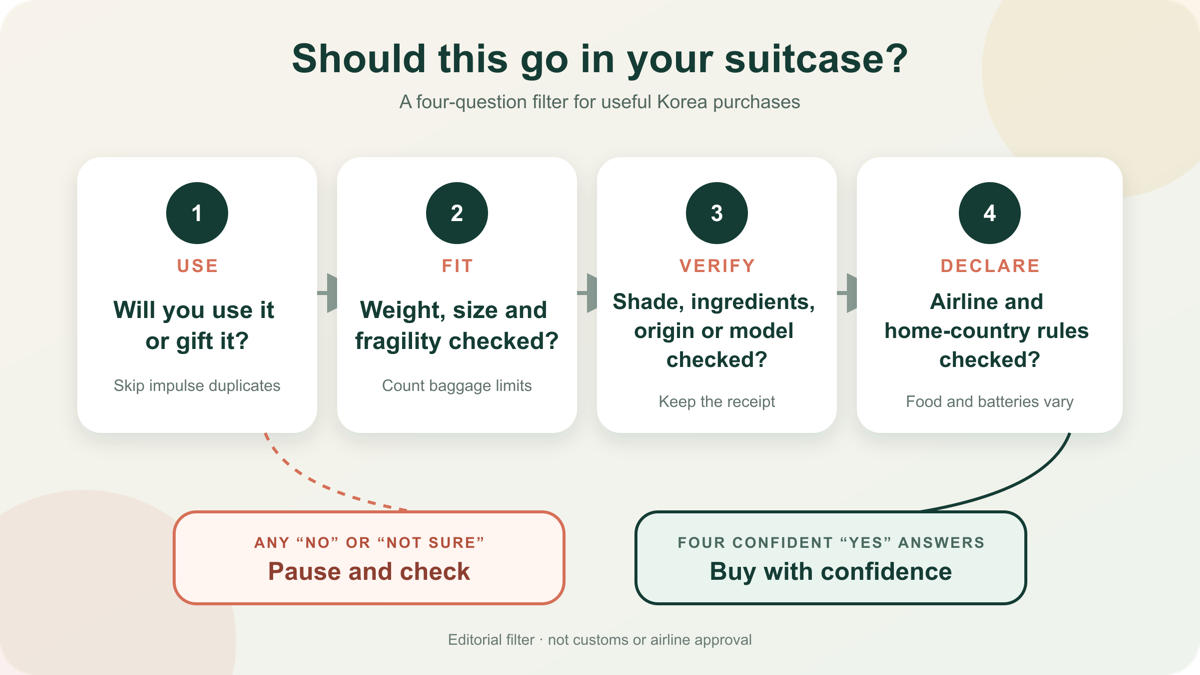
A low price is not enough. Run every purchase through four questions: Will I use it? Does it fit? Did I verify the exact item? and Can I legally take it home? That sequence prevents most regret purchases.
| Planning budget | A sensible basket | What to avoid |
|---|---|---|
| Under ₩20,000 | Hanji cards, a small snack assortment, socks, stickers or one sheet-mask set | Several random duplicates just because each item looks cheap |
| ₩20,000–₩60,000 | One tested beauty item plus one food or design gift | Buying a full routine you have never tried |
| ₩60,000–₩150,000 | A small ceramic or lacquer piece, local designer accessory, or curated mixed basket | Bulky packaging that consumes your baggage allowance |
| Above ₩150,000 | Only an item whose authenticity, warranty, voltage, return terms and home-country price you checked | Assuming premium, duty-free or Korean-made automatically means best value |
These are editorial planning bands, not promised prices. Promotions and bundle sizes change constantly. Use the Korea card, cash and ATM fallback plan before a large purchase, and always choose Korean won if a payment terminal offers expensive dynamic currency conversion.
1–5. K-beauty worth considering
1. Sheet masks for easy, low-commitment gifts
Sheet masks are flat, light and easy to divide among friends. Check the expiry date, ingredient list and purpose instead of buying only by character art or a large discount sign. A multipack is useful when the recipients have similar skin needs; mixed single masks are better when you want variety.
2. A sunscreen you have tested
Korean sunscreen is widely available, but “popular” does not guarantee compatibility. Test texture and fragrance, confirm the product is intended for your face or body, and remember that regulatory labels differ by country. This article does not rank protection claims or replace local medical advice.
3. Cushion foundation and sealed refills
A cushion foundation is portable and distinctly associated with Korean beauty retail. Match the shade in natural light and compare the amount of product, not only the case design. Refills are lighter than collecting several decorative compacts, but confirm that the refill fits the exact case.
4. Cleansing products or travel-size routines
A cleanser, cleansing balm or small travel set can be more useful than an untested ten-step routine. For international flights departing Incheon Airport, carry-on liquids and gels must be in containers of 100 ml or less and fit inside one resealable transparent 1 L bag. A partially empty container larger than 100 ml still fails that screening rule. Checked-baggage acceptance, airline dangerous-goods rules, transfer screening and destination import rules remain separate.
5. Hair, scalp or body-care products
Hair and body care can be more practical than adding more face products. Avoid treatment or growth claims you cannot verify. Choose by texture, fragrance and container size, and do not buy an aerosol until you have checked both Incheon Airport and your airline’s rule.
For a branch-specific route, payment timing, tax-refund question and return-policy cautions, use the Olive Young Central Myeongdong Town guide. Buy one test item early in the trip, then return for a larger purchase only if it works for you.
6–11. Food gifts that are easier to pack
6. Gim, or seasoned dried seaweed
Gim is light, recognizable and sold in both snack packs and gift boxes. The tradeoff is volume: large boxes contain a lot of air. Choose intact, sealed packaging, check the best-before date and protect thin sheets from crushing.
7. Korean tea or instant coffee sticks
Tea bags, roasted-grain tea and single-serve coffee sticks are compact office or family gifts. Read the ingredient panel because sweetened mixes can contain milk powder, sugar or allergens. Keep the original box if your destination asks for ingredient or origin information.
8. Packaged snacks, candy and yakgwa
Small multipacks work well when you need several inexpensive gifts. Try one packet during the trip before buying a case. Choose products that are factory sealed and shelf stable, and check nuts, dairy, gelatin and wheat when shopping for someone with dietary restrictions.
9. Ramyeon and shelf-stable meal kits
Dry noodles and compact meal kits recreate part of the trip at home. Cup packaging is bulky, so flat packets usually pack better. Inspect the ingredient list: some soup bases contain meat, seafood or dairy, which can change whether the food is admissible at your destination.
10. Gochujang, doenjang and cooking sauces
These are useful for travelers who actually cook. They are also liquids or gels for aviation security, even when they look like food paste. Choose a sealed, durable container, wrap it against leaks and place containers over 100 ml in checked baggage. Never assume a transfer airport will accept an opened duty-free liquid bag.
11. Sealed regional specialties
A local tea, confection or packaged pantry product from Busan, Jeju, Gyeongju or another stop can feel more connected to your trip than a national convenience-store item. Use the first-trip destination guide to match a regional gift to your itinerary. Avoid fresh produce, fresh meat, dairy, loose seeds and unpackaged plant material unless you have checked the current import rule.
Food rule: “sealed” and “commercially packaged” make inspection easier, but they do not guarantee admission. The United States requires travelers to declare agricultural products; Australia requires declaration of specified food, plant and animal products; Great Britain and Canada apply product-specific restrictions. Keep packaging and receipts, check the official destination tool, and declare when required.
12–18. Traditional crafts and Korean design gifts
12. Hanji stationery
Hanji paper cards, notebooks, envelopes and small lampshades are lightweight and visually connected to Korean craft. Paper quality and production method vary, so ask what is handmade and what is simply printed with a traditional motif.
13. Bojagi fabric pouches or wraps
A fabric wrap can become gift packaging, a travel organizer or home storage. Flat fabric pieces pack easily and avoid the fragility of ceramics. Choose stitching and fabric you would use, not only a pattern that photographs well.
14. A stainless spoon-and-chopstick set
A Korean spoon-and-chopstick pair is compact, useful and easy to find. Select a comfortable weight and a washable finish. Ordinary dining utensils are not the same as sharp cooking tools; pack anything pointed or unusually heavy according to airline security guidance.
15. One small ceramic piece
A tea cup, tiny dish or incense holder preserves the material feel of Korean design without filling a suitcase. Inspect the glaze and base, ask for protective wrapping and place the item inside clothing in the middle of checked baggage. If provenance matters, use a museum, gallery or identified maker instead of assuming every blue-and-white piece is Korean-made.
16. Mother-of-pearl or lacquer accessories
Small mirrors, boxes, bookmarks and jewelry can deliver the visual impact of najeonchilgi without the weight of furniture. Ask about the material and maker, compare hinges and surface finish, and avoid wildlife materials whose species or import status you cannot confirm.
17. Museum-shop and award-winning tourism goods
Museum and heritage shops are strong places to find modern objects based on Korean collections rather than generic flag merchandise. Korea Tourism Organization’s current traditional-gift guide highlights recent Tourism Souvenir Competition selections, while the National Souvenir Center in Insadong sells screened and award-winning products.
18. Korean prints, postcards and illustrated books
Paper goods are the easiest option when baggage space is almost gone. Choose a real place you visited, a museum collection you saw or an illustrator you want to support. Protect corners with a notebook or rigid folder.
19–25. Fashion, stationery and fandom gifts
19. Socks, handkerchiefs and small textiles
These make practical gifts when size information is simple. Check fiber content, stitching and country of manufacture. A Korean motif does not prove the item was made in Korea.
20. Pens, stickers and notebooks
Korean stationery is available at many price points, stays light and is easy to personalize by recipient. Test pens before buying, avoid overpacking duplicate notebooks and choose designs you can use beyond the trip.
21. A local designer accessory
A cap, small bag, scarf or jewelry piece can be a better personal souvenir than trend-driven clothing. Try it on, photograph the care label and compare the same model online. Korean sizing can differ from the labels you use at home, and many boutiques have limited exchange policies.
22. Official K-pop albums or merchandise
Buy for a known artist, version and recipient. Albums can have multiple versions and randomized inclusions, so check the exact package before payment. Use an official retailer or clearly authorized shop and avoid photocards or luxury collaborations whose authenticity you cannot establish.
23. Licensed character goods
A pouch, keyring or desk item works when the recipient already likes the character. Look for a proper copyright or licensing mark and a normal receipt. “Korean style” alone is not proof of licensed merchandise.
24. Regional pins, magnets and small location goods
These are best when tied to a place you visited, such as a museum, palace, city or island. One meaningful piece is usually stronger than a bag of interchangeable souvenirs.
25. A custom Hangeul name seal
A small dojang can be a personal keepsake, but it is only successful when the spelling is right. Prepare the intended name in Hangeul, confirm the layout before carving and treat it as a souvenir—not as a substitute for a legally registered seal.
Where should you shop?
| Shop type | Best for | Main caution |
|---|---|---|
| Beauty specialty store | Comparing textures, shades, travel sizes and current bundles | Do not buy a routine only because it is viral or discounted |
| Large supermarket | Gim, noodles, tea, coffee and packaged snacks | Bulk boxes consume space; check ingredient and destination rules |
| Museum or heritage shop | Collection-based design, crafts and screened gifts | Premium does not mean every item is handmade |
| Traditional market or Insadong | Craft browsing, fabrics, seals and small gifts | Ask price, material and origin before customization |
| Department or duty-free store | Premium goods, consolidated service and last-minute purchases | Duty free is not automatically the lowest total price |
| Official fandom store | Albums, licensed character goods and current releases | Confirm version, inclusion and return terms |
For a concentrated first shopping area, use the Myeongdong station, hotel and shopping guide. For a specific shop, save the Korean name, address and phone number with the Korean address and NAVER Map workflow rather than trusting a similar English branch name.
What should you think twice about buying?
- Untested skincare in bulk: ingredients and texture matter more than social-media popularity.
- Health supplements or traditional remedies: possible medication interactions, product claims and destination import rules require qualified advice.
- Large electronics: check voltage, plug, language, warranty, cellular bands and home-country price.
- Power banks: Korea’s rules effective April 20, 2026 limit passengers to two power banks rated 160 Wh or less, prohibit checked-baggage packing and in-flight use or charging, and require short-circuit protection. Products above 100 Wh also need airline approval. Your carrier or destination may be stricter, so check again before departure.
- Aerosols, self-defense products and flammable items: security restrictions can make them unusable as souvenirs.
- Fresh, loose or animal-based food: customs risk is much higher than for a clearly labeled shelf-stable product.
- Counterfeit luxury or unofficial fandom goods: low price does not remove authenticity, customs or consumer-protection risk.
- Heavy ceramics and alcohol: weight, breakage, liquid security and destination allowance can erase the value.
Pack, refund and declare in the right order
- Keep receipts and original packaging. They help with returns, tax-refund evidence, customs origin questions and insurance.
- Separate liquids and fragile pieces as you shop. For international flights departing Incheon Airport, carry-on liquid and gel containers must be 100 ml or less and fit in one resealable transparent 1 L bag. Checked-baggage, airline, transfer-airport and destination rules still apply.
- Keep spare lithium batteries and power banks out of checked baggage. Under Korea’s April 20, 2026 rule, power banks rated 160 Wh or less are limited to two per passenger and cannot be used or charged in flight; products above 100 Wh need airline approval. Protect the terminals and follow any stricter carrier rule.
- Keep refund goods unused and available for inspection until export when required. Korea Customs can require the purchased goods, passport and sales document when confirming export.
- Complete any airport tax-refund or customs inspection before surrendering the relevant checked bag. Follow the Incheon Airport tax-refund baggage sequence.
- Declare at home when required. A Korean tax refund does not cancel your destination’s customs, biosecurity, food or personal-allowance rules.
The complete Korea tourist tax-refund guide explains eligibility, immediate versus general refund and the documents to retain. A refund is a tax process, not proof that the product is allowed into your home country.
Frequently asked questions
What is the single best souvenir to buy in Korea?
There is no universal winner. For a practical low-risk choice, buy one item connected to your trip that is light and easy to use: hanji stationery, a spoon set, packaged tea, a tested beauty item or a museum-shop object.
Is K-beauty always cheaper in Korea?
No. Promotions can be strong, but compare the exact size, refill count, exchange rate and home-country sale price. The main advantage is often selection and in-person testing rather than a guaranteed percentage saving.
Can I bring kimchi, gochujang or cosmetics in carry-on baggage?
Kimchi, pastes, lotions, gels and similar products are treated as liquids or gels for international security. Each carry-on container normally must be 100 ml or less and fit in the permitted clear bag; larger containers belong in checked baggage if otherwise allowed. Your destination’s food rules are separate.
What gifts are easiest for coworkers?
Individually wrapped snacks, tea, coffee sticks, sheet masks, pens, stickers and small paper goods divide easily. Check allergies and destination food rules before buying food for a group.
Where can I find souvenirs that are actually Korean-made?
Start with museum shops, K-Heritage stores, the National Souvenir Center and identified makers. Then read the country-of-origin label and ask about the maker; a Korean motif or Seoul location is not proof of manufacture.
Should I wait for duty free at the airport?
Only for an item whose price and availability you already checked. Airport duty free can simplify premium or last-minute shopping, but selection, pickup rules and transfer-liquid restrictions can make an in-city purchase better.
Can I get a tax refund on souvenirs?
Eligible foreign visitors can receive a refund at participating stores when the purchase and export conditions are met. Ask before payment, bring your passport, retain the refund documents and keep the goods available for any required export confirmation.
How much empty suitcase space should I leave?
Decide by airline weight, not only visible space. A foldable tote helps organize purchases, but it does not increase your checked or carry-on allowance. Weigh the bag before the final shopping day.
Official sources
- Korea Tourism Organization: must-buy item categories
- Korea Tourism Organization: 2026 traditional gift guide
- Korea Tourism Organization: National Souvenir Center
- Korea Customs Service: tourist tax-refund export confirmation
- Incheon Airport: restricted-item FAQ for liquids, aerosols and batteries
- Korean Ministry of Land, Infrastructure and Transport: April 2026 power-bank rules
- IATA: dangerous-goods guidance for passengers
- Korea Tourism Organization: finalized 2025 Foreign Tourist Survey
- Korea Tourism Organization: tourist tax-refund conditions
- U.S. Customs and Border Protection: bringing food into the United States
- GOV.UK: bringing food into Great Britain
- Australian Department of Agriculture: bringing or mailing goods
- Canadian Food Inspection Agency: bringing food into Canada
Update history: first fully verified edition prepared July 22, 2026. This guide is independent and does not guarantee product suitability, customs admission, airline acceptance or tax-refund eligibility.