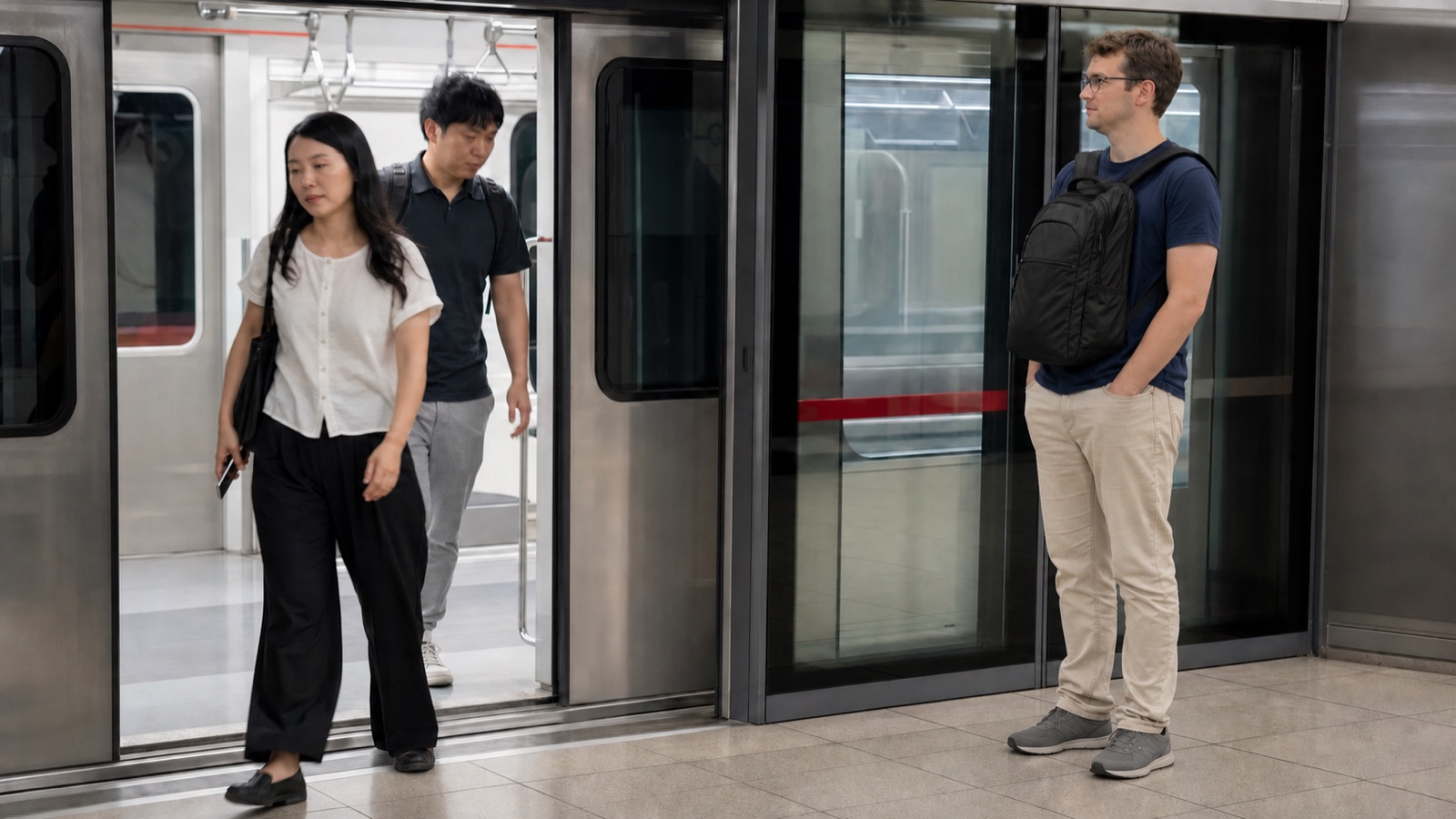
The short version: wait beside the door markings, leave the center open, let everyone exit, and then board in order. Leave priority seats available unless you need one, leave pink seats for pregnant passengers, control your bags and sound, and never question another passenger’s need based on appearance.

Checked July 21, 2026
This guide uses current Seoul government, Visit Seoul and national safety guidance. Seat designs and platform markings can vary by city and rail operator, so follow the signs on your actual train.

Korea subway etiquette in 60 seconds
| Situation | Best visitor action | Type |
|---|---|---|
| Train arriving | Wait beside the door and keep the center clear | Official guidance |
| Doors open | Let all passengers exit before boarding | Official guidance |
| End-of-car priority seats | Leave them available unless you need one | Official guidance |
| Pink seat | Leave it for a pregnant passenger | Official guidance |
| Large backpack | Wear it in front or put it between your feet | Official guidance |
| Phone or video | Use earphones and keep calls short and quiet | Official guidance |
| Escalator | Stand, hold the rail and do not walk or run | Official safety guidance |
| Elevator | Let riders exit, then give priority to those who need it | Accessibility courtesy |
Priority seats are not only “elderly seats”
The Korean term 교통약자석 is better understood as priority seating for passengers with reduced mobility. Korea’s legal definition of transport-vulnerable passengers includes people with disabilities, older adults, pregnant passengers, people traveling with infants, children and others who have difficulty moving.
On many trains, the main priority area is at both ends of each car. The exact upholstery color, sign and number of seats can vary. Do not use color alone: look for pictograms above the seats and signs on the platform.
What should a visitor do?
- If you do not need the seat, leave it available when practical.
- If you genuinely need it because of disability, injury, illness, pregnancy or another mobility limitation, use it.
- If someone nearby appears to need your regular seat more, quietly offer it by standing or gesturing. A long explanation is unnecessary.
- Never demand that another rider prove a disability or medical condition.
Do not judge by age or appearance. Someone sitting in a priority area may have chronic pain, an injury, a non-visible disability or early pregnancy. Courtesy means creating access, not policing strangers.
What does the pink subway seat mean?
The pink seat marked 임산부 배려석 is for pregnant passengers. Seoul introduced the high-visibility design because people in early pregnancy may need a seat even when their pregnancy is not visible. The city’s recommended etiquette is to keep these seats open so they are immediately available.
The useful visitor decision does not depend on debating penalties: Seoul asks passengers to leave the seat open for pregnant people. Use another seat when you are not pregnant, and do not confront a rider whose circumstances you cannot know.
Does the official guidance require a Korean pregnancy badge?
The official guidance reviewed for this article identifies the seat by pregnancy, includes early pregnancy and does not state that a Korean badge is required. Our reading is therefore that a pregnant visitor may use it. A badge can help other riders recognize the need, but it should not be used to judge or challenge another passenger.
How to queue and board correctly
- Find the door position. Platform screen doors and floor markings show where the train doors will stop.
- Join the side queue. Stand behind the last waiting person rather than forming a new row in front.
- Keep the middle open. This is the exit path.
- Step back when the doors open. Give passengers enough width to leave with luggage, a stroller or a wheelchair.
- Board after the last exiting passenger. Move into the car instead of stopping immediately inside the doorway.
The paint pattern is not identical at every station. Some platforms show arrows, boxes or multiple queues. The principle is consistent even when the artwork changes: sides for waiting, center for exiting.
Before your first ride, use the T-money vs Climate Card guide to choose what you will tap at the gate. A foreign bank card that bought a ticket is not automatically the card used for travel.
If you are standing at the door
At a busy stop, step onto the platform temporarily so people behind you can get off. Stand to one side, allow the exit flow to finish, and re-enter before new riders behind the waiting line. Do not plant a suitcase in the center of the doorway.
Backpacks, suitcases and shopping bags
- Backpack: wear a large pack in front or place it between your feet while holding the strap.
- Suitcase: keep it upright beside you, brace it on curves, and keep wheels out of the aisle.
- Shopping bags: gather handles so packages do not spread across an adjacent seat.
- Door area: do not block the wheelchair space, emergency equipment or passenger flow.
Large luggage is not automatically banned, but rush hour makes it hard to manage. If your route is flexible, avoid roughly 7:30–9:00 a.m. and 5:30–7:30 p.m. on weekdays. This is an editorial planning range, not an operator rule.
Phone calls, videos and conversation
Seoul’s current public-service campaign asks passengers to use earphones when watching videos, listening to music or making calls. Use silent mode, keep notification sounds off and do not play media through the phone speaker.
If you must answer a call, speak briefly and quietly. For a longer conversation, wait until you leave the train. The same restraint helps when talking with travel companions in a quiet carriage.
Food and drinks: subway and bus rules differ
On a subway, avoid strong-smelling, messy or spill-prone food. Do not describe this as the same legal rule that applies to Seoul city buses.
On a Seoul city bus, a driver may refuse a takeaway cup or open food that can spill or leak. A sealed bottle, unopened can or properly closable tumbler is generally allowed. Finish an open coffee before entering the bus queue or seal it safely in your bag.
Escalators and elevators
Escalators
The current safety direction is not “always walk on the left.” Stand in two lines where possible, remain inside the yellow boundary, hold the handrail and do not walk or run. During events or heavy congestion, follow staff, barriers and announcements.
Elevators
Let people exit first. Then give boarding priority to wheelchair users, people with strollers, older adults, pregnant passengers, injured travelers and others for whom stairs or escalators are not practical. Elevators are not forbidden to everyone else, but a traveler who can comfortably use another route should yield limited space.
Bus lines, doors and card taps
At a Seoul bus stop, join the route-specific line or follow the waiting pattern already formed. Not every stop has the same painted layout. Most Seoul buses use the front door for boarding and rear door for exiting; press the stop button in advance and follow the driver’s directions if accessibility boarding changes the door.
Tap your transport card both when boarding and leaving. The exit tap is used to calculate distance and transfer discounts. A bus can sometimes charge several people to one card if you tell the driver first, but every subway rider normally needs a separate card and multi-person transfers are restricted.
Useful Korean transport signs
| Korean | Meaning | Recognition tip |
|---|---|---|
| 교통약자석 | Priority seating | Look for several mobility pictograms |
| 임산부 배려석 | Pregnancy priority seat | Usually highlighted in pink |
| 내리는 문 | Exit door / doors opening | Watch the display before your stop |
| 타는 곳 | Boarding place / platform | Common on station direction signs |
| 환승 | Transfer | Follow the line color and number |
| 엘리베이터 | Elevator | Use the wheelchair-accessible route signs |
Common mistakes
- Calling every priority area an elderly seat: the eligible group is broader.
- Assuming a pink seat is ordinary seating: it is specifically for pregnant passengers.
- Confronting another rider: a need may be invisible.
- Entering as soon as the doors open: keep the center clear until everyone exits.
- Following an outdated “walk on one side” escalator habit: current safety guidance says not to walk or run.
- Playing navigation audio aloud: use earphones and watch the station display.
- Forgetting to tap off a bus: this can affect the fare and transfer discount.
- Bringing an open takeaway cup onto a Seoul bus: the driver may refuse boarding.
Frequently asked questions
Can a tourist use a priority seat?
The official guidance reviewed describes priority-seat users by mobility need rather than nationality. If you genuinely need the seat, use it; if you do not, leave it available. The area is not only for older Korean passengers, and another rider’s need may not be visible.
Can I sit in the pink pregnancy seat if I am not pregnant?
Seoul asks passengers to leave the seat open for pregnant people. The respectful choice is to use another seat and avoid forcing someone to request it. Do not confront another rider, because early pregnancy and other circumstances may not be visible.
Do I need a pregnancy badge to use the pink seat?
The official guidance reviewed for this article does not state that a Korean badge is a condition of use. It identifies the seat by pregnancy and includes early pregnancy. Our reading is that a pregnant visitor may use it; the badge simply helps make the need visible.
Which side should I stand on an escalator in Korea?
Do not plan around a permanent walking lane. Current safety guidance favors standing in two lines, holding the rail and not walking or running. Follow the markings and announcements at the station you are using.
Can I take luggage on the Seoul subway?
Yes, ordinary travel luggage is allowed. Keep it under control and out of doors, aisles and wheelchair spaces. An airport bus or taxi can be more comfortable during rush hour or when a station route lacks a convenient elevator.
Can I drink coffee on public transport?
Avoid eating or drinking in a way that smells or spills on the subway. For Seoul city buses, a driver may refuse a spill-prone takeaway cup or open food. A sealed bottle or closable tumbler is generally acceptable.
Do I tap my transport card when leaving?
Yes. Tap at both ends of a bus or subway trip. This records the distance and is required for integrated transfer discounts. The exact fare can still increase with distance, so “transfer discount” does not always mean every later ride costs zero.
Official sources
- Korean Law Information Center: definition of transport-vulnerable passengers
- Visit Seoul: priority seats, backpacks and boarding etiquette, edited December 3, 2025
- Seoul Metropolitan Government: subway earphone campaign
- Ministry of the Interior and Safety: escalator safety guidance and 2026 two-line direction
- Seoul public-transport use guide
- Seoul city-bus food and drink restrictions
Update history: first fully verified edition prepared July 21, 2026. Seat design and operating details can vary by city and rail operator; local signs take priority.