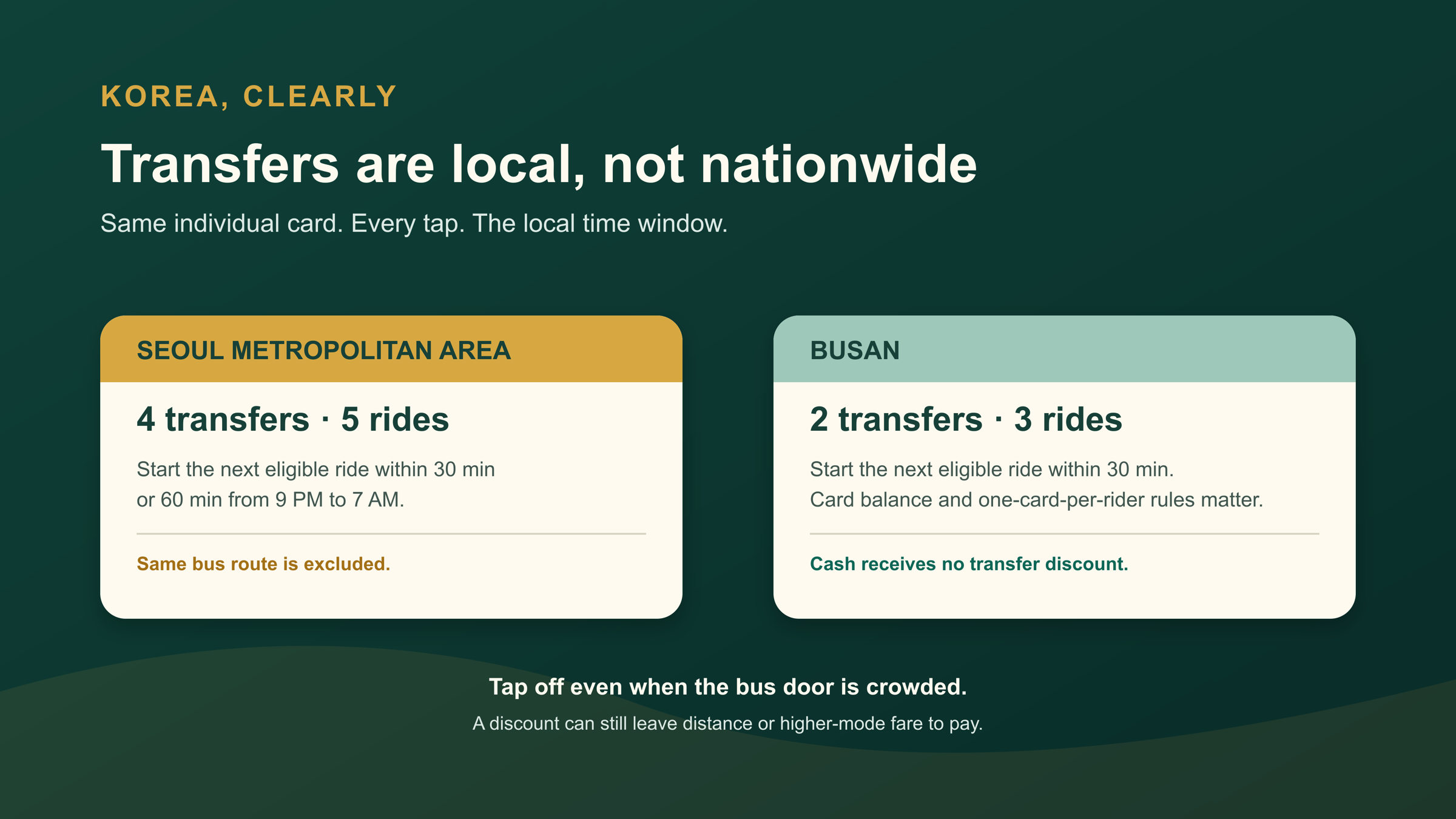
The short answer: Korea does not have one universal transfer rule. Use the same individual transit card, tap at every entry and exit, and start the next eligible ride within the local time window. In the Seoul metropolitan system, the usual limit is four transfers; in Busan, it is two. Cash, a missed tap-off or the same bus route can remove the discount.
Rules checked September 4, 2026
Seoul’s official guidance allows up to four transfers, or five rides, when each tap and time condition is met. Busan’s live bus information system allows up to two transfers, or three rides. These are regional fare rules, not a promise for every Korean operator.
Use the same card and the rule for that city
A transfer discount links rides recorded on one fare credential. It does not follow your passport, payment card or travel companion. Give each adult or independently charged rider a separate compatible transit card unless the operator explicitly supports a different arrangement.
| Rule | Seoul metropolitan area | Busan |
|---|---|---|
| Maximum linked journey | 4 transfers / 5 rides | 2 transfers / 3 rides |
| Next eligible boarding | Within 30 minutes; 60 minutes from 9 PM to 7 AM | Within 30 minutes |
| Tap-off | Required to calculate the linked fare | Required to receive the transfer discount |
| Cash | Not part of the card-linked discount | No transfer discount |
| Same bus route | Excluded as a transfer | Excluded as a transfer |
| What “discount” means | The system can still charge distance or the difference for a higher base fare | |
The Seoul clock runs from the previous tap-off to the next tap-on. Its longer late-night window applies from 9 PM to 7 AM. Busan’s official BIMS page uses a 30-minute window. Elsewhere, read the local operator page rather than extending either rule nationwide.
Make one transfer correctly
- Load enough balance before boarding. A card that cannot pay the required fare may break the linked journey. Standard physical-card top-up is safest to plan in won.
- Tap once when entering. Wait for the reader’s confirmation. Do not stack several cards or a phone against the reader.
- Tap off before leaving. On a bus, move toward the door early enough to reach the reader. On the subway, use the exit gate normally.
- Begin the next eligible ride in time. The deadline concerns the next tap-on, not when that bus or train reaches the destination.
- Use the same individual card. Switching from one T-money or Cashbee card to another starts a separate fare record.
- Read the balance and fare display. A successful beep alone does not tell you whether a discount was applied.
A transit card is not the same as an overseas contactless bank card. Before assuming a foreign Visa or Mastercard can tap a gate, use the T-money, Climate Card and foreign-card comparison. The cards and cash guide covers top-up backup.
Know what breaks the discount
Missing the tap-off: the system cannot close the ride normally or establish the correct transfer time. The next boarding may be charged as a new trip, and some operators may apply an additional fare.
Reboarding the same route: Seoul and Busan exclude a same-number bus as a discounted transfer. Leaving bus 100 and boarding another bus 100 is not the ordinary transfer pattern, even inside the time window.
Paying cash: Busan explicitly says cash fares receive no transfer discount. In any city, cash cannot carry the electronic journey record from one vehicle to the next.
Sharing one card: a bus driver may be able to charge several passengers for one ride, but that does not make every later bus or subway transfer eligible. Seoul’s bus guidance specifically excludes subway transfer treatment for a multi-passenger transaction. Use one card per rider for predictable transfers.
Running out of balance: Busan’s system warns that insufficient balance can prevent the benefit. Reload before a transfer sequence, especially when a longer distance or higher-fare mode could add a charge.
Recover after a missed tap or unexpected fare
First, do not hold up the gate or step into traffic to retap. Move to a safe place and preserve the card. Note the card number or masked identifier, route, boarding and exit stops, time, displayed amount and vehicle number if visible.
- If the gate will not open, use the nearby intercom or staffed gate. Do not tailgate another passenger.
- If the bus ride ended without a tap-off, do not assume a later tap will repair it. Ask the current operator or a staffed transit information point what record they can inspect.
- If the balance is low, reload through a supported channel before the next ride. Keep cash available for a standard physical card.
- If the fare looks wrong, keep any receipt and contact the regional operator. Describe the taps and times; request an explanation before asserting that every additional charge is refundable.
Transfer discounts reduce eligible linked fares; they do not make every later ride free. Seoul’s integrated system can charge the highest base fare plus distance. Busan may also collect the relevant fare difference. Plan by total journey cost, not by the word “free.” For calmer boarding behavior, see the Korea subway etiquette guide.
Frequently asked questions
How many public-transport transfers can I make in Seoul?
Up to four transfers, making five linked rides, when each mode, tap and time rule is satisfied. Reboarding the same bus route is excluded.
How long do I have to transfer in Busan?
Busan’s live bus information page says to board the next eligible mode within 30 minutes of tapping off. The linked journey allows up to two transfers.
Is a Korean transit transfer always free?
No. A discount can remove a duplicate base fare while distance or a higher-mode difference remains. Missed taps, cash, same-route reboarding and local exclusions can also produce a new fare.
Official sources
- Seoul Metropolitan Government: public-transport transfer rules
- Seoul Metropolitan Government: integrated subway fare
- Seoul Metropolitan Government: bus fares and multi-passenger rule
- Busan Bus Information Management System: transfer guide
- Busan Metropolitan City: public transportation and cash fares
Update history: first verified edition prepared September 4, 2026. Recheck the regional operator before travel. A reader display and current operator rule take priority over this comparison.