Best first-trip default: stay around Myeongdong, Euljiro 1-ga or City Hall for central sightseeing. Choose Hongdae for the all-stop AREX and nightlife, Jongno/Insadong for palaces, Gangnam for a south-Seoul itinerary, Seongsu for cafés and pop-ups, Dongdaemun for late shopping, or Seoul Station for an airport or KTX transfer.
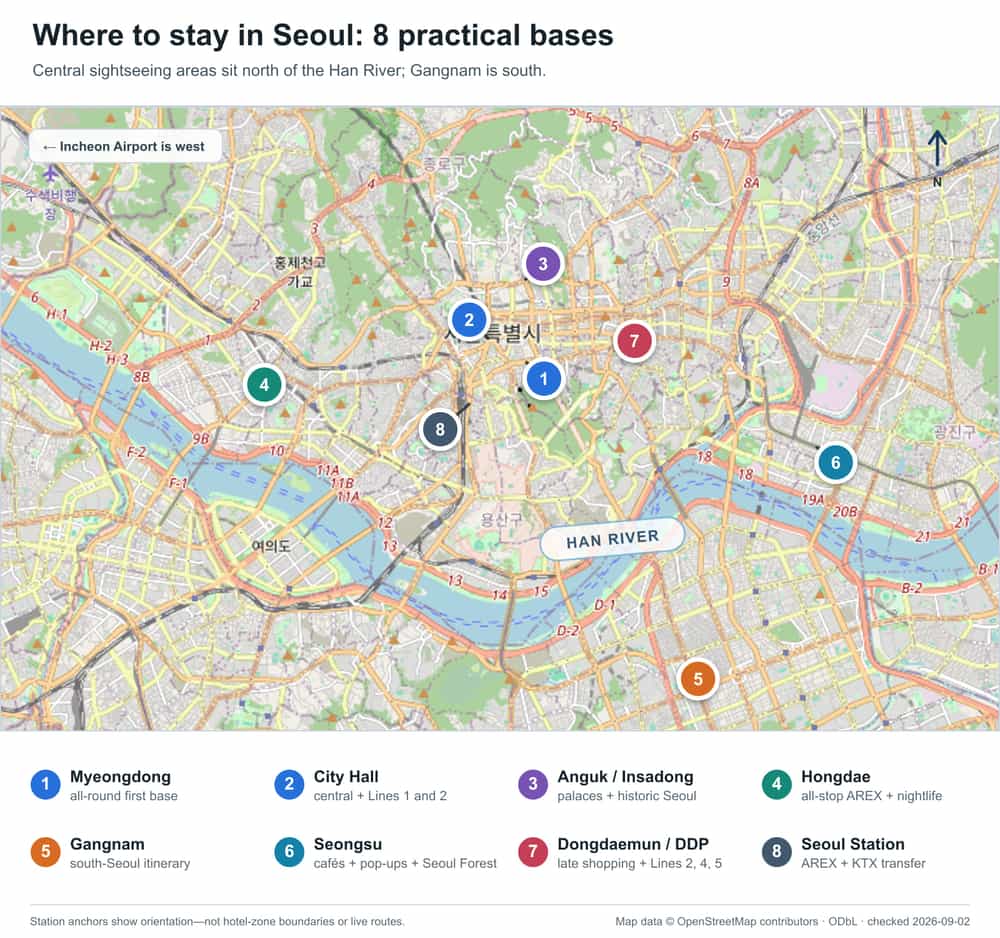
See the 8 areas on one Seoul map
Use this overview to understand which side of the Han River each base is on. The numbered points are station anchors, not hotel-zone boundaries. Tap the map or a button to open the live location in Google Maps, then check the exact hotel entrance and final walking route before booking.
Use two map layers: Google Maps makes each area easy to open on an international phone. Before paying for a hotel, use the Korean-address and NAVER Map workflow to confirm the exact entrance, station exit, slope and final luggage walk.
Area and transport details checked July 22, 2026
Station connections, airport-rail stops and neighborhood access were checked against Seoul Metropolitan Government, Seoul Tourism Organization and current public-transport maps. Hotel names, airport-bus stops, check-in times and elevator routes can change, so verify the exact property rather than booking from a neighborhood label alone.
Best default: a hotel within a manageable walk of Myeongdong Station, Euljiro 1-ga or City Hall. Better specialist choices: Hongdae for airport rail and nightlife; Jongno for historic Seoul; Gangnam for a south-river itinerary; Dongdaemun for late retail and Lines 2, 4 and 5.
Where to stay in Seoul at a glance
| Area | Best for | Useful stations | Main tradeoff |
|---|---|---|---|
| Myeongdong / City Hall | First trips, central sightseeing, shopping and easy fallback options | Myeongdong, Euljiro 1-ga, City Hall | Busy streets and hotel quality that varies block by block |
| Jongno / Insadong | Palaces, hanok streets, museums and a calmer historic-center base | Anguk, Gwanghwamun, Jongno 3-ga | Fewer late-night choices on some quieter lanes |
| Hongdae | All-stop AREX, nightlife, cafés and a younger atmosphere | Hongik Univ. | Noise and a long station-to-hotel walk if you choose the wrong exit |
| Gangnam | Business, COEX, K-pop, clinics and south-Seoul plans | Gangnam, Samseong, Bongeunsa | Longer rides to the royal-palace and Jongno core |
| Seongsu / Seoul Forest | Cafés, pop-ups, Seoul Forest and east-Seoul shopping | Seongsu, Ttukseom, Seoul Forest | Hotel inventory is scattered, and palace-heavy days require more travel |
| Dongdaemun | Late shopping, DDP, markets and multi-line access | Dongdaemun History & Culture Park | A functional commercial base rather than a quiet neighborhood stay |
| Seoul Station | Short stays, AREX, KTX and early intercity departures | Seoul Station | The station is large; the wrong side adds an awkward luggage walk |
Do not choose by district name alone. Seoul hotel listings often use a famous area name even when the entrance is one or two subway stops away. Compare the exact Korean address, nearest station entrance, gradient and late-night walk before paying.
1. Myeongdong and City Hall: the best all-round first base
Myeongdong is the simplest recommendation when a first trip combines palaces, markets, Namsan, shopping and evening food. The practical hotel zone spans Myeongdong Station (명동역) on Line 4, Euljiro 1-ga (을지로입구역) on Line 2 and the City Hall edge. Seoul’s official tourism guide identifies Myeongdong as a major shopping area and lists Myeongdong Station Exits 5–10 for the central streets.
- Stay near Myeongdong Station for Line 4, Namsan and the busiest pedestrian shopping lanes.
- Stay near Euljiro 1-ga for Line 2, Lotte, City Hall and a generally flatter northern approach.
- Stay near City Hall for Lines 1 and 2, Deoksugung, Gwanghwamun and easier movement toward Seoul Station.
The tradeoff is intensity. A hotel above a restaurant lane or close to the central shopping streets may be lively after dark. Check recent noise comments, room-facing direction and the last 300 meters from the station. For a block-by-block decision, use the complete Myeongdong station, hotel-zone and walking guide.
Choose this area if: you want one dependable base and do not yet know which Seoul neighborhood will become your favorite. Skip it if: nightlife in Hongdae or a daily appointment in Gangnam matters more than central sightseeing.
2. Jongno, Gwanghwamun and Insadong: best for historic Seoul
This is the strongest base for travelers who plan to spend real time at Gyeongbokgung, Changdeokgung, Bukchon, Insadong, museums and traditional-culture venues. It is not one compact hotel strip, so use the station that matches the itinerary:
- Anguk Station (안국역), Line 3: closest to Insadong, Bukchon and Changdeokgung.
- Gwanghwamun Station (광화문역), Line 5: useful for Gwanghwamun Square, offices and the south side of Gyeongbokgung.
- Jongno 3-ga (종로3가역), Lines 1, 3 and 5: excellent network access, but the atmosphere changes quickly between busy avenues and small evening lanes.
Jongno works especially well for an early palace start because you can avoid crossing the city before breakfast. The quieter parts of Insadong and Bukchon may have fewer very-late dining options than Hongdae or Gangnam. Bukchon is also a residential area with a restricted-tourist red zone, so a hotel address near “Bukchon” is not permission to treat residential lanes as a night attraction.
Choose this area if: palaces, museums and walkable historic streets are the center of the trip. Skip it if: you want clubbing or large modern shopping complexes outside the hotel every night.
3. Hongdae: best for airport rail, nightlife and late energy
Hongik University Station (홍대입구역) is served by Line 2, the Gyeongui–Jungang Line and the all-stop Airport Railroad. Seoul’s official airport guide shows the all-stop AREX route calling at Hongik University before reaching Seoul Station; the nonstop Express Train does not stop at Hongik University.
That makes Hongdae convenient for travelers who want a direct rail ride from Incheon Airport without a downtown subway transfer. It also offers a dense mix of restaurants, cafés, live music, shops and late activity. The same strengths create its main risks: weekend crowds, street noise and deceptively long walks inside and around the station.
- For the airport: confirm that your train is the all-stop service and that the chosen exit has a practical elevator route.
- For sleep: prefer a side street away from the loudest entertainment blocks, then check the nighttime approach on a map.
- For a broader area: hotels marketed as Hongdae may actually sit toward Yeonnam, Hapjeong or Sinchon. That can be a benefit, but it changes the station and walk.
Choose this area if: you value a youthful atmosphere, airport access and late meals. Skip it if: most mornings begin at the royal palaces or you are highly sensitive to noise.
4. Gangnam: best when the trip is mostly south of the river
“Gangnam” covers a large area, not one station. Gangnam Station (강남역) is a Line 2 and Shinbundang interchange surrounded by offices, restaurants and shopping. Samseong (삼성역) and Bongeunsa (봉은사역) serve the COEX and World Trade Center area; the official Seoul listing places COEX between Samseong on Line 2 and Bongeunsa on Line 9.
Choose the exact subarea based on the daily anchor. Gangnam Station is useful for business meetings and evening dining; Samseong/COEX suits exhibitions, indoor shopping and events; Apgujeong or Cheongdam is a different, more dispersed choice for fashion and entertainment-company interests.
The cost of choosing Gangnam is not necessarily the room rate—it is cross-city time. A palace-heavy itinerary repeatedly crosses the Hangang and adds transfers. Airport transport also depends heavily on the exact hotel and time of day, so compare the current airport bus, rail-plus-subway and taxi routes rather than assuming “Gangnam” has one airport solution.
If Lotte World is a fixed day, Jamsil is easier from the Line 2 side of Gangnam than from many north-Seoul hotel zones. Read the Lotte World Magic Pass buying guide before treating a paid skip-the-line option as guaranteed.
Choose this area if: business, COEX, K-pop or south-Seoul appointments dominate. Skip it if: this is a short first visit centered on Myeongdong, Jongno and the palaces.
5. Seongsu: best for cafés, pop-ups and Seoul Forest
Seongsu is a useful specialist base when cafés, fashion and beauty pop-ups, local shopping and Seoul Forest shape several days. Seongsu Station (성수역), Line 2 is the clearer anchor for the eastern café and retail blocks. Seoul Forest Station (서울숲역), Suin–Bundang Line sits closer to the park and the western side of the district. Visit Seoul lists Seoul Forest access from Seoul Forest Station Exits 3–4 and Ttukseom Station Exit 8.
The tradeoff is first-trip efficiency. Hotels are more scattered than in Myeongdong, and a palace-heavy itinerary requires more cross-city travel. A property marketed as “Seongsu” may actually be closer to Ttukseom, Seoul Forest, Konkuk University or Wangsimni, so compare the exact station and final walk.
Start with the Seongsu cafés, shops and Seoul Forest route, then use the Seongsu shopping street and map guide. Choose this area if: Seongsu itself is a repeated trip anchor. Skip it if: this is a short first visit centered on Myeongdong, Jongno and the palaces.
6. Dongdaemun: best for late shopping and multi-line access
Dongdaemun History & Culture Park Station (동대문역사문화공원역) connects Lines 2, 4 and 5. DDP, fashion malls, traditional wholesale areas and Cheonggyecheon make this a useful base for shoppers and travelers who want east–west and north–south subway options.
Be precise: Dongdaemun Station and Dongdaemun History & Culture Park Station are different stations. A hotel marketed as Dongdaemun may also be closer to Euljiro, Sindang or Jongno 5-ga. Check the actual entrance and do not assume every market keeps the same late-night hours; official Seoul listings repeatedly note that hours vary by facility or shop.
Choose this area if: shopping, DDP or a multi-line transport base matters. Skip it if: you want a quiet residential mood or direct AREX access.
7. Seoul Station: best for a short transfer-heavy stay
Seoul Station combines the Airport Railroad, KTX and subway Lines 1 and 4. It is practical when you arrive from Incheon, leave early by train or have only one night between transport legs. For a longer sightseeing stay, compare the blocks toward Namdaemun with a more central Myeongdong or City Hall base rather than treating every property labeled “Seoul Station” as equivalent.
The station itself is large, and roads, rail lines and slopes separate nearby blocks. “Five minutes from Seoul Station” can mean a comfortable indoor connection or an unpleasant luggage route across a major road. Save the building’s Korean name and road address, then inspect which station side and exit serve the lobby.
Choose this area if: an airport or KTX transfer controls the schedule. Skip it if: you have several nights and value evening neighborhood atmosphere more than transport efficiency.
How to choose the exact hotel block
If a Paju DMZ tour is part of the itinerary, compare the operator’s exact meeting point and departure time before choosing a hotel only for “pickup convenience.” Keep the original identification required by the DMZ tour passport checklist ready on the travel day.
| Check | Why it matters | What to save |
|---|---|---|
| Exact station and exit | One neighborhood can span several lines and steep or crowded blocks | Station name, exit number and elevator location |
| Korean road address | English hotel names and map pins can be duplicated or outdated | Korean name, road address and phone number |
| Airport handoff | The best train or bus depends on the final 300–800 meters | Stop name, final walk and late-arrival fallback |
| Noise and slope | Nightlife, arterial roads and Namsan-side hills change room comfort | Recent room-facing and access reviews |
| Luggage plan | Older stations may have an indirect elevator path | Accessible exit and storage or early-arrival policy |
| Cancellation terms | Plans can change before a long-haul trip | Exact deadline, payment currency and taxes |
Use the Korean-address and NAVER Map workflow to match the property. A polished booking-platform pin is not enough: compare the road address and telephone number with the hotel’s own confirmation.
If a concert is the trip anchor, fix the venue before the neighborhood. The August K-pop concert schedule and venue pins makes it easier to see whether the useful base is east Seoul, Gocheok, central Seoul or the Incheon Airport area.
Airport access should confirm—not choose—the neighborhood
Airport convenience matters most on arrival and departure day; neighborhood fit affects every day in between. Seoul’s official airport guide identifies the AREX all-stop stations at Hongik University, Gongdeok and Seoul Station, while the Express Train runs nonstop to Seoul Station. Myeongdong, Jongno, Dongdaemun and Gangnam require a transfer, airport bus or taxi.
- Pick the area that reduces daily sightseeing travel.
- Compare the exact hotel’s current airport bus stop, AREX transfer and official taxi route.
- Check the final train or bus for your arrival time; do not assume daytime service after a late flight.
- Keep a taxi fallback and show the driver the Korean road address.
The Incheon Airport to Seoul comparison explains AREX, buses and taxis, while the late-night Incheon arrival guide covers the hours when the normal choice may no longer operate.
Common first-time booking mistakes
- Booking a district instead of a station. Gangnam, Jongno and even Myeongdong cover multiple practical hotel zones.
- Counting subway stops but not transfers. A two-transfer route with luggage can be harder than a slightly longer direct ride.
- Assuming the nearest exit has an elevator. Use current station accessibility information and accept a longer but step-free route when needed.
- Optimizing only for the airport. A direct arrival is not worth five days of unnecessary cross-city travel.
- Ignoring the nighttime block. Review the route after dark, especially around nightlife streets and large road crossings.
- Splitting a short stay between hotels. Changing rooms consumes checkout, luggage and navigation time; keep one base unless the itinerary genuinely moves to another city.
Mobility and stroller note: station accessibility is improving, but an elevator may be far from the closest hotel exit and older streets can include slopes or uneven paving. Confirm the complete street-to-platform path rather than relying on an accessibility icon alone.
Frequently asked questions
What is the best area to stay in Seoul for a first visit?
Myeongdong, Euljiro 1-ga or City Hall is the most practical all-round choice for many first trips. These central zones balance shopping, historic Seoul, multiple subway lines and easy fallback options. Choose another area when one priority clearly dominates.
Is Myeongdong or Hongdae better?
Choose Myeongdong for central sightseeing, shopping and easier access to the palace side of Seoul. Choose Hongdae for the all-stop AREX, nightlife, cafés and a younger atmosphere. Hongdae is not served by the nonstop AREX Express Train.
Should I stay in Gangnam on my first Seoul trip?
Yes when business, COEX, K-pop or south-Seoul appointments shape most days. For a short palace-and-market itinerary, central Seoul usually saves more time even if a Gangnam hotel appears newer or cheaper.
Is it better to stay near Seoul Station?
It is excellent for a one-night transfer, AREX or an early KTX departure. For a longer sightseeing stay, City Hall, Myeongdong or Jongno may offer a better evening environment while remaining close to the station.
How close should a Seoul hotel be to the subway?
There is no universal distance, but the route should remain comfortable with luggage, rain and late-night arrival. Inspect the actual entrance, crossings, slope and elevator—not only the booking site’s straight-line distance.
Should I change hotels to see both north and south Seoul?
Usually not on a first trip. Seoul’s subway makes day trips across the river practical, while a hotel move consumes a large part of a day. Split the stay only for a long visit or a schedule anchored in two genuinely distant zones.
Official sources
- Seoul Metropolitan Government: 2026 official tourist map
- Seoul Metropolitan Government: subway map and fare information
- Seoul Tourism Organization: getting to Seoul by AREX, airport bus and taxi
- Visit Seoul: Myeongdong area and station access
- Visit Seoul: Hongik University Station connections
- Visit Seoul: Insadong and nearby stations
- Visit Seoul: COEX, Samseong and Bongeunsa access
- Visit Seoul: Dongdaemun Design Plaza
- Visit Seoul: Seoul Forest and nearby stations
Update history: first evidence-led edition prepared July 22, 2026. Recheck station works, airport transport, hotel access and neighborhood operating conditions immediately before booking.