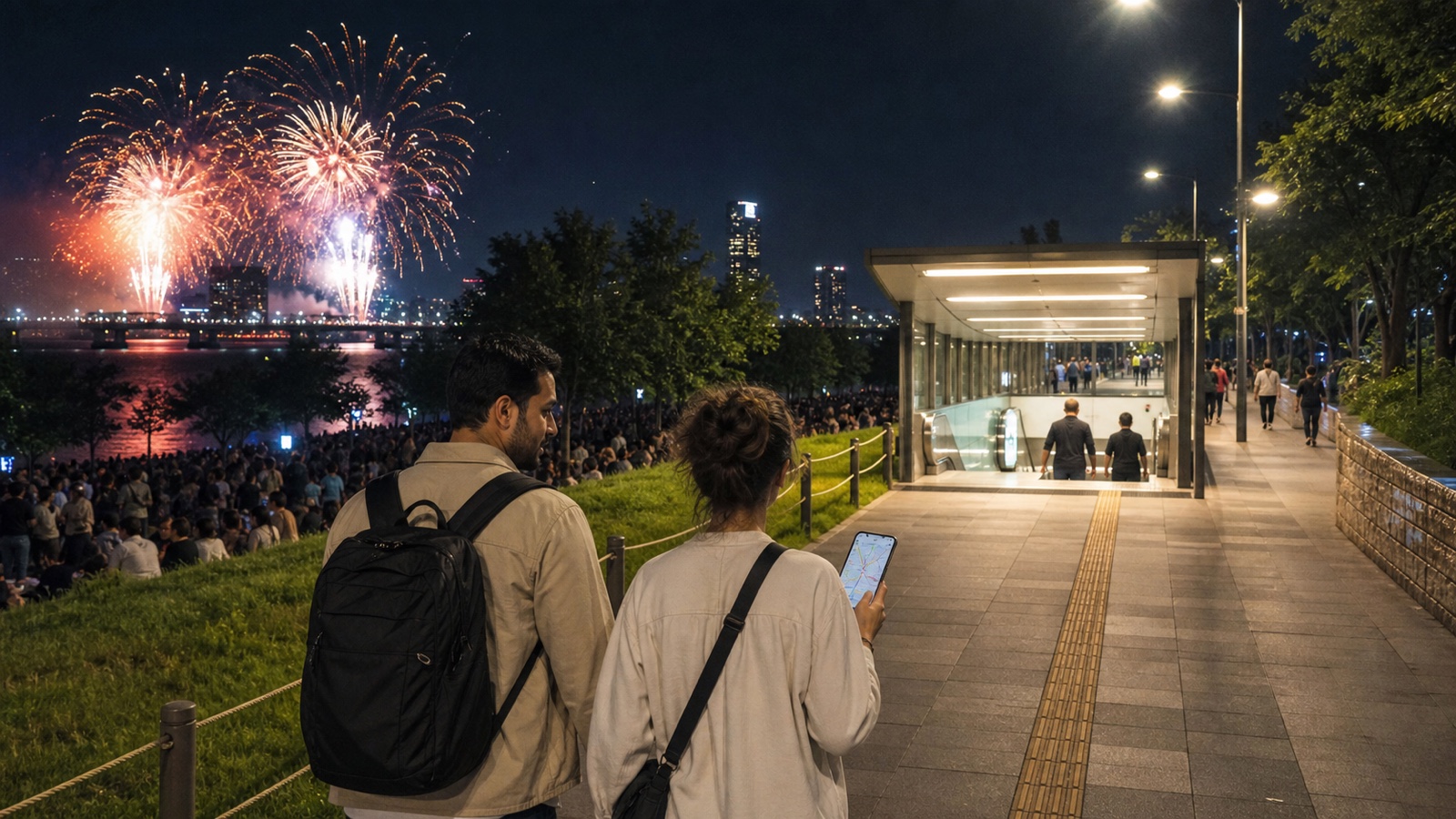
The answer: build your Seoul fireworks subway plan around an alternative station, not Yeouinaru alone. Seoul warns that Yeouinaru Station may be bypassed or have exits closed when festival crowds become severe. Choose your station from your viewing side of the river, load your transit card before arriving, screenshot the route and wait about 30 minutes after the finale if conditions allow.
Checked August 19, 2026
The festival is September 5 at Yeouido Hangang Park. A final 2026 station-bypass and road-control timetable has not been published on the English Seoul pages checked for this article. Use the stations below as advance planning, then follow Seoul TOPIS, Seoul Metro and on-site instructions on the day.
Why Yeouinaru can break your return plan
Yeouinaru Station on Line 5 is the name most visitors associate with Yeouido Hangang Park. That makes it useful on an ordinary day and fragile during the fireworks festival. Seoul’s standing festival guidance says trains may bypass the station or exits may close depending on congestion. Even when it remains open, an entry queue can erase any advantage of being physically close.
The common mistake is planning only the inbound trip. After the show, the route reverses at the exact moment everyone else moves. The better approach is to walk away from the river flow toward a station that already points toward your hotel. Do not cross a bridge merely to reach a more familiar station; stay on your viewing side unless officials direct otherwise.
First choose a place using the view and crowd comparison. If you hold a Nodeul ticket, read the ticket pickup and restricted-entry details rather than following the main Yeouido crowd.
Seoul fireworks subway alternatives by area
| Where you watched | Station options | Useful direction |
|---|---|---|
| Central or northern Yeouido | Yeouido (Lines 5/9), National Assembly (Line 9) | Choose by Hongdae/Gongdeok or Gangnam direction |
| Eastern Yeouido near the 63 Building | Saetgang (Line 9/Sillim), Daebang (Line 1) | Avoid walking back into Yeouinaru flow |
| Ichon Hangang Park | Ichon (Line 4/Gyeongui–Jungang), Sinyongsan (Line 4) | Remain north of the river |
| Nodeul Island paid zone | Nodeul (Line 9), Noryangjin (Lines 1/9) | Follow the ticketed-zone exit instructions first |
| Mapo north-bank viewpoint | Mapo (Line 5), Gongdeok (Lines 5/6, AREX, Gyeongui–Jungang) | Useful for Hongdae and central Seoul |
These are orientation choices, not a promise that every entrance will remain open. Staff may create one-way pedestrian flows or temporarily restrict an entrance. If a route conflicts with barriers or police instructions, follow the controlled route.
| Viewing side | Primary station pin | Backup station pin |
|---|---|---|
| Central or northern Yeouido | Yeouido Station (여의도역) | National Assembly (국회의사당역) |
| Eastern Yeouido / 63 Building side | Saetgang Station (샛강역) | Daebang Station (대방역) |
| Ichon north-bank side | Ichon Station (이촌역) | Sinyongsan (신용산역) |
| Nodeul ticketed zone | Nodeul Station (노들역) | Noryangjin (노량진역) |
| Mapo north-bank side | Mapo Station (마포역) | Gongdeok (공덕역) |
Save both pins for your viewing side. Station entrances and pedestrian paths can be restricted on festival day, so treat the pins as orientation and obey the live controlled route.
Pick the line that matches your hotel
- Hongdae: Line 5 toward Gongdeok allows a transfer to AREX or the Gyeongui–Jungang Line; Line 9 toward Dangsan can connect to Line 2. Choose the station with the safer visible queue.
- Myeongdong: from the north bank, Ichon gives a direct Line 4 direction. From southern Yeouido, Line 9 toward Dongjak connects with Line 4, while Line 1 from Daebang reaches Seoul Station for Line 4.
- Gangnam: Line 9 from Saetgang, Yeouido or National Assembly serves the south-of-river corridor. Do not walk north merely to use Line 5.
- Jamsil: Line 9 can connect at Sports Complex for Line 2 or at Seokchon for Line 8. Expect transfer stations to be busy too.
Check the final destination shown on the platform, not only the line color. Set up the Seoul subway and map apps before the event and save the hotel name and road address in Korean. Google Maps pins in this article show approximate location; they are not the authority for closures or event-day walking controls in Korea.
The practical post-show exit plan
- Load your card before the afternoon. Do not join a vending-machine line after the finale. The T-money guide explains purchase and top-up separately.
- Screenshot two routes. Save your preferred station and one backup, plus the hotel’s Korean address.
- Set a reunion point. Choose a visible landmark outside the densest riverside area in case calls or messages fail.
- Let the first wave move. The organizer says leaving about 30 minutes later can make the return more comfortable. Stay only where officials allow and keep emergency paths clear.
- Walk with the managed flow. Do not push toward a closed entrance or reverse through a one-way crowd.
- Use a taxi only after dispersing. If necessary, walk well away from road closures before opening the foreigner-friendly taxi-app comparison. A pickup near the venue is unlikely to save time.
Do not invent a 2026 closure time from an old festival notice. Check the current Seoul TOPIS, station displays and the festival notice page before leaving your hotel.
Frequently asked questions
Will Yeouinaru Station close for the 2026 fireworks?
It may be bypassed or have exits restricted if crowding requires it, but the exact 2026 timetable was not yet posted in the official English guidance checked on August 19. Follow live notices rather than assuming a fixed closure.
What is the best station after the Seoul fireworks?
There is no single best station. Saetgang or Daebang suits the eastern Yeouido side; Yeouido or National Assembly suits other parts of the island; Ichon suits the north-bank park. Match the station to your viewing position and hotel line.
Should I drive or reserve parking?
Public transport and walking are safer defaults because roads and bus routes can be controlled. A reserved parking space does not guarantee a quick approach or exit through the event area.
Official sources
- Hanwha: confirmed date, venue, notices and exit advice
- Seoul Metropolitan Government: festival subway and crowd guidance
- Seoul TOPIS: live transport and road information
Update history: verified August 19, 2026. Update immediately when Seoul publishes the final 2026 road, bus and station-control plan.