A driver who pulls you away from the official queue is not giving you a shortcut. At Gimhae International Airport, use the marked taxi stand, confirm whether the car is a standard or deluxe taxi, show the Korean destination and watch the meter. The airport publishes reference fares, so a surprise fixed price should be questioned before the car moves.
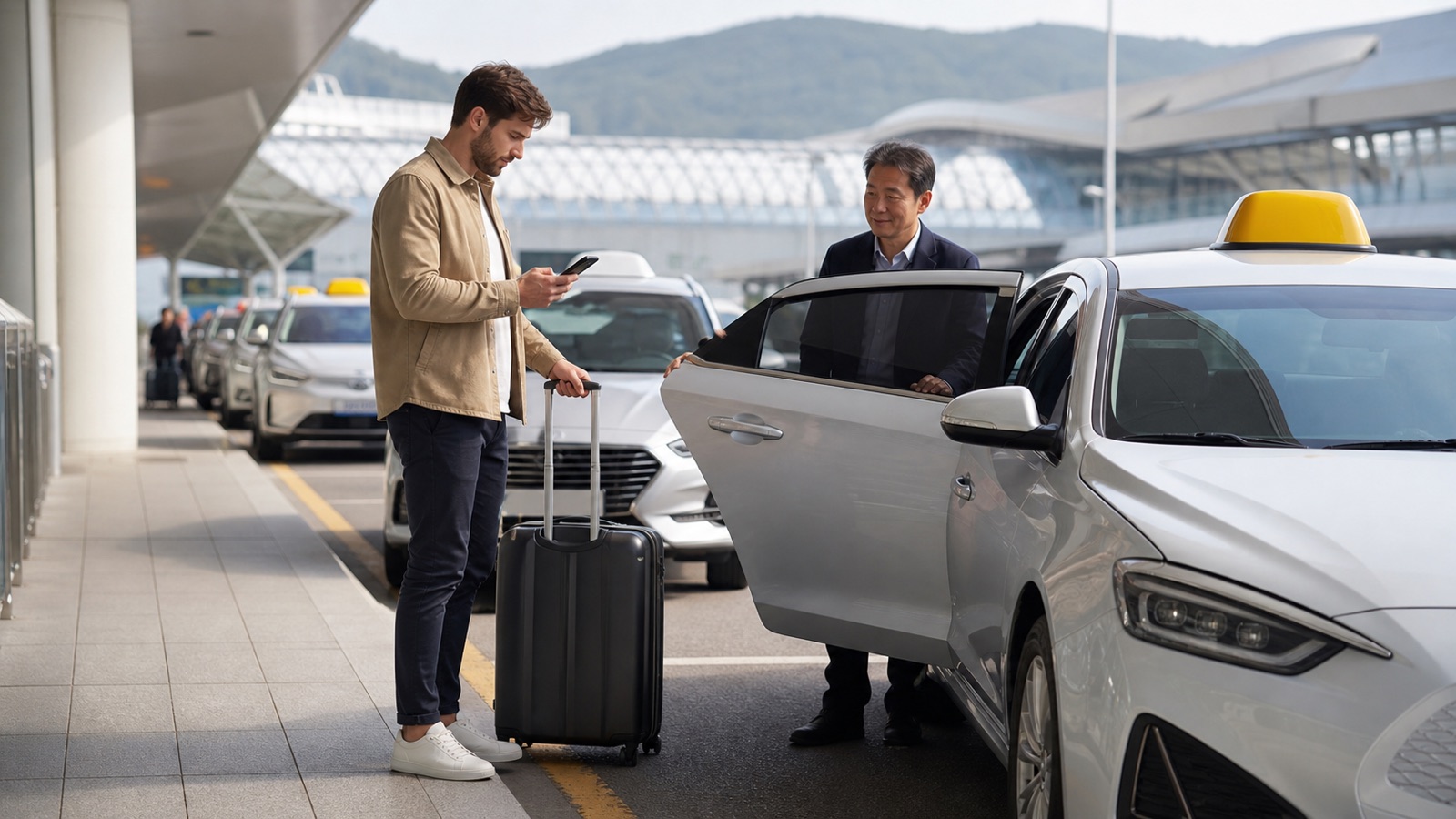
Fares and airport guidance checked August 19, 2026. The official Gimhae Airport page lists a standard Busan taxi base fare of ₩4,800 for the first 2 km. Traffic, route, waiting time and surcharges change the final meter total.
Start at the official Gimhae Airport taxi stand
Gimhae International Airport, 김해국제공항
108 Gonghangjinip-ro, Gangseo-gu, Busan 46718
부산광역시 강서구 공항진입로 108
The airport’s accessibility page places the taxi stand across the road from International Terminal Gate 3. Follow current terminal signs because construction or traffic control can move a queue. Do not follow someone who approaches inside the terminal and insists that the official line is closed.
Five checks before the taxi moves
- Use the queue. Board only at the signed taxi area or a vehicle matched in a taxi app.
- Confirm the taxi type. Deluxe and large taxis have a higher official base fare than a standard taxi. A higher meter is not automatically fraud if you chose the higher category.
- Show the exact Korean destination. “Haeundae” is a district; a Korean hotel name and map pin prevent a costly misunderstanding.
- Check the meter. Ask before departure if the driver proposes a flat fare. Ordinary city trips should follow the applicable meter and surcharge rules.
- Keep the evidence. Photograph or note the plate, keep the card receipt and save the route shown in your app.
Useful Korean: 미터기 켜 주세요 (Please turn on the meter) and 카드로 결제할게요 (I will pay by card). Say the destination first; use these phrases only when needed.
Use the airport estimates as a reasonableness check
| Published example destination | Standard taxi estimate | Published travel time |
|---|---|---|
| Seomyeon, Lotte Hotel area | ₩18,000 | 45 minutes |
| Nampo-dong, Jagalchi Market | ₩20,000 | 60 minutes |
| Haeundae, Paradise Hotel area | ₩25,000 | 70 minutes |
| Gwangalli | ₩25,000 | 70 minutes |
These are airport reference estimates, not guaranteed quotes. Congestion and the exact address can increase time and fare. Busan currently adds a late-night surcharge of 20% from 11 PM to midnight, 30% from midnight to 2 AM and 20% from 2 AM to 4 AM. Trips outside the taxi’s operating area can also trigger an official out-of-area surcharge.
A price difference is not enough to prove a scam. First check taxi type, traffic, late-night time band, out-of-area travel and the actual route. Report the evidence when the meter was refused, the destination was changed without reason or the charge cannot be explained.
Normal variation versus a real warning sign
A slow trip on a rainy Friday night, a visible late-night surcharge or a deluxe taxi’s higher base fare can all be legitimate. A route may also look indirect when a bridge, tunnel or divided road controls the turn. Compare the live route before accusing the driver.
Stop and ask questions when the driver refuses the meter without a clear official reason, hides the taxi type, demands cash before departure, changes the agreed destination, or quotes a large fixed amount while steering you away from the signed stand. If you are already inside, stay calm and move the conversation to a staffed hotel, police station or airport desk.
Set up your phone before landing
- Save the hotel’s Korean name, road address and phone number as a screenshot.
- Save the route in a Korean map app so you can compare direction and arrival time.
- Keep the 1330 and 112 numbers visible without needing airport Wi-Fi.
- Have one payment backup and enough battery to preserve the receipt and route.
If something goes wrong
Do not create a confrontation while the vehicle is moving. Ask to stop in a safe, staffed place. Save the plate, receipt, pickup time, destination, payment record and screenshots of the route or app booking.
- Immediate danger: call police at 112.
- Tourist help or complaint: call 1330 in Korea or use the official online complaint center.
- Language assistance in Busan: the city lists 051-120 for its call center; service hours and languages can change.
The full taxi-overcharge guide shows how to organize the evidence and complaint. If you have not chosen an app, compare the visitor-friendly options in the Korea taxi-app guide.
When you do not need a taxi
The Busan–Gimhae Light Rail connects Airport Station with Sasang, where you can transfer to Busan Metro Line 2. Airport limousine routes serve selected Seomyeon, Haeundae and Gijang stops, but route tables change. Use the current airport page instead of an old blog screenshot. For the complete onward route, open the Busan arrival and station guide.
Frequently asked questions
Are taxis at Gimhae Airport safe?
Most trips are routine. Reduce risk by using the official queue or an app-matched car, confirming the taxi type and destination, checking the meter and keeping the receipt.
Should I agree to a fixed airport fare?
Ask why it is not using the ordinary meter and compare it with the airport’s published reference. Do not enter if the explanation, taxi type or total is unclear.
Can I pay a Busan taxi by foreign card?
Card acceptance is common, but a foreign issuer or terminal can still fail. Keep a second card or enough won for a safe fallback and request a receipt.
Official sources
- Korea Airports Corporation: Gimhae Airport transportation
- Busan Metropolitan City: taxi fares and public transportation
- VISITKOREA: 1330 helpline and complaint center
Verified August 19, 2026. Recheck airport queue signs, fares, surcharges and bus routes on the travel date.