You have a cup of noodles and a hot-water machine—but does the sauce go in now, and should you drain the water? Korean cup noodles do not all use the same method. Read the cooking panel before opening the sachets. Below, follow a soup-cup example, locate the water line, and learn when the draining or microwave instructions change the process.
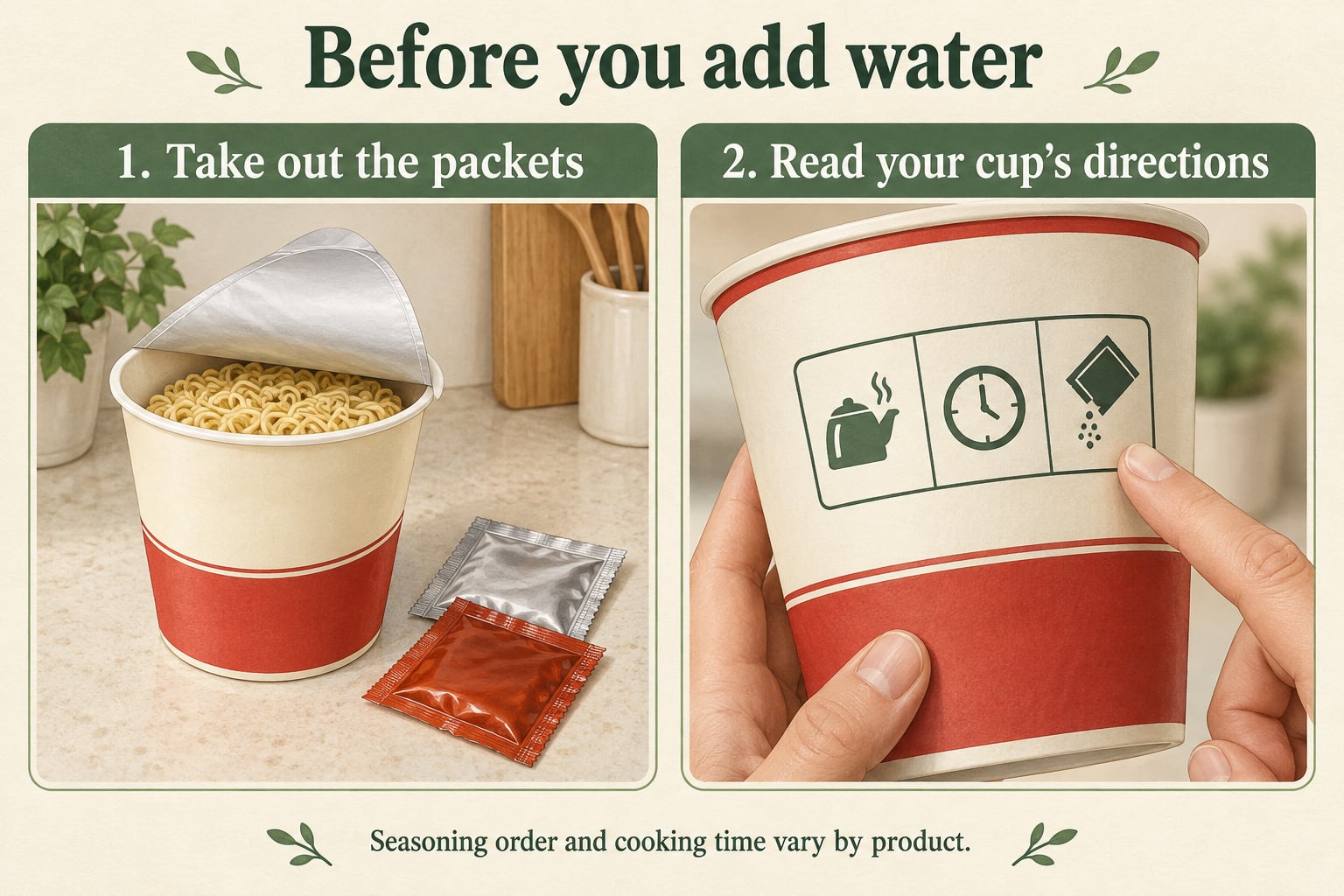
Checked September 10, 2026. The illustrations use generic packaging, not an exact product label. The numbered soup example is specifically for the Korean-market Shin Ramyun Cup, 65g. Your own package takes priority. Tap a picture to enlarge it.
Before buying: check the cup and the equipment
Start with a cup or bowl that includes its own cooking container. A flat packet may require a saucepan or a dedicated noodle cooker; do not buy one expecting a hot-water dispenser to do the same job. Check that this branch allows preparation and has the equipment your product needs.
If you plan to eat immediately, look for the preparation counter and seating before checkout. Do not assume every branch has either. Pay before opening the food, take chopsticks if supplied, and keep your receipt if you need to ask about the purchase.
Choose by preparation method as well as flavor. An unfamiliar spicy sauce is not made mild simply because the front shows cheese or cream. Read ingredients and allergen information if you avoid particular foods; the photograph on a cup is not a complete ingredient list.
Shopping for several items? Our 1+1 and 2+1 convenience-store guide explains the quantities and combinations to check before paying. For a first meal, one manageable cup is more useful than a promotion you cannot finish or prepare.
| Look for | Meaning | Why it matters |
|---|---|---|
| 조리방법 / 조리법 | Cooking directions | Read the complete sequence. |
| 끓는 물 / 표시선 | Boiling water / marked line | Find the correct filling level. |
| 분말스프 / 액상스프 | Powder seasoning / liquid seasoning | Check when each is added. |
| 물을 버린 후 | After draining the water | Do not skip the draining step. |
| 물을 버리지 마세요 | Do not drain the water | A sauce-style cup can also say this. |
| 전자레인지 / 분 | Microwave / minutes | Check the method, wattage and time. |
Steps 1–3: make the Shin Ramyun 65g soup cup
Nongshim’s official Shin Ramyun instructions list this small cup separately from the packet and larger bowl. For the Korean 65g cup, the method is:
- Open to the indicated arrow. Take out the seasoning packet, open it, and add the powder onto the noodles.
- Add boiling water to the inner marked line. Use the line inside this cup, not the rim or a water quantity copied from a different size.
- Close the lid and wait about three minutes. Stir well before eating. This is a soup preparation; do not drain away the broth before serving.
That three-minute example is not a timer for every product called Shin, every large bowl, or every noodle sold abroad. Check the exact name, weight and instructions in your hand.
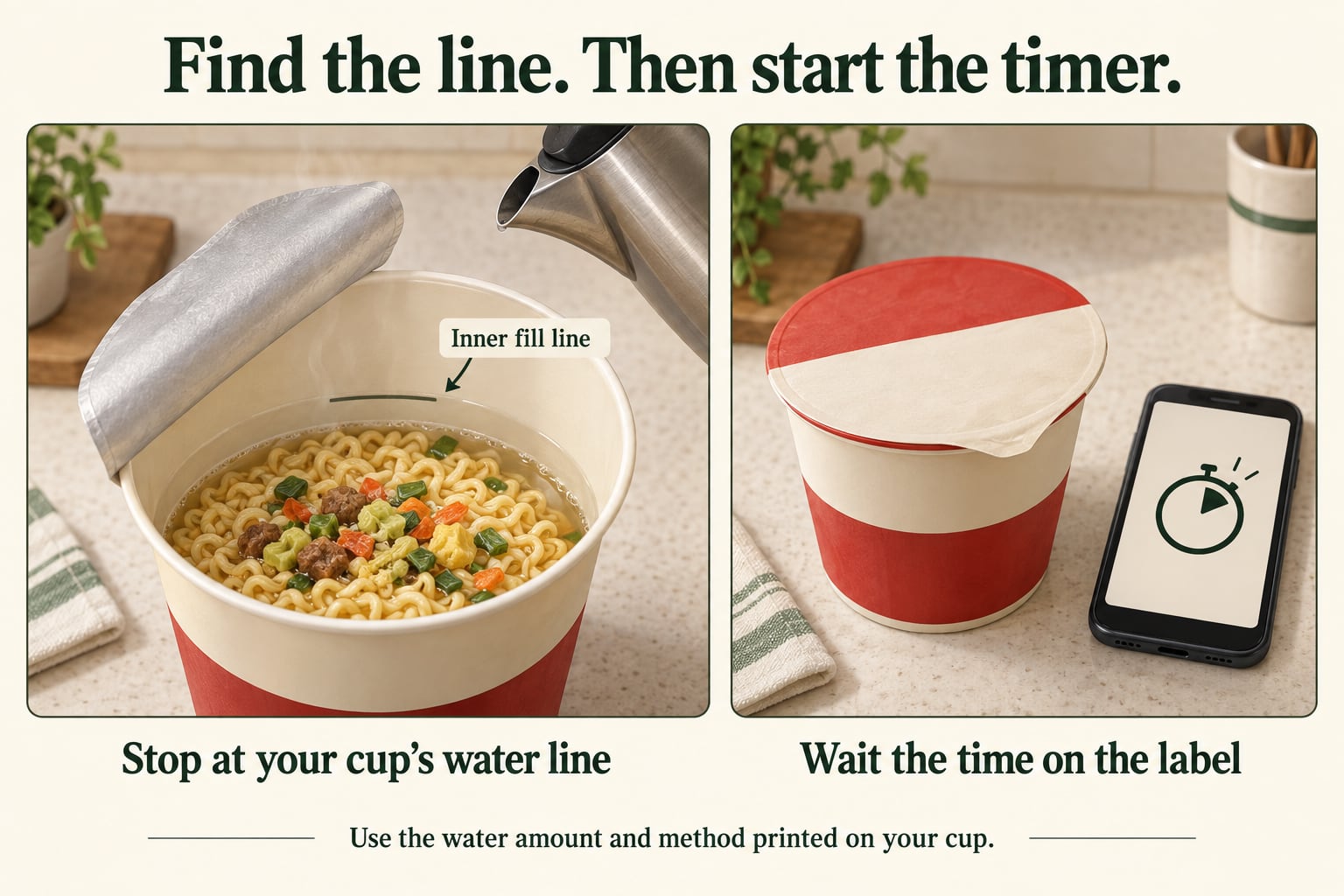
Keep the cup upright on a stable surface while filling. Locate the line before steam makes it harder to see, keep your fingers clear of the water outlet, and stop the flow before moving the cup. If the machine controls are unclear, ask staff rather than pressing several buttons.
Start your timer after adding the water and closing the lid. Leave the cup on the counter or table while waiting; do not walk through a crowded shop holding an open container of boiling liquid. Open the lid away from your face when it is ready.
Soup or sauce: decide before pouring anything away

A soup cup is served with broth. A sauce-style cup is finished by mixing noodles with seasoning, but the preparation can involve draining, retaining a specified amount of water, or using a no-drain method. The finished-food picture alone does not tell you which sequence applies.
For example, Samyang America’s Buldak Original Cup directions put draining before the sauce and flakes. That is an American-market example of a different sequence—not a replacement instruction for every Buldak cup bought in Korea.
Conversely, Nongshim’s Chapagetti The Black bowl launch announcement describes a no-drain microwave method. Do not assume “black-bean sauce” means “pour the water away.” Read the current pack.
If draining is required, first find the designated liquid-disposal area. Follow the pack’s opening instructions and keep your hands away from escaping steam. Do not improvise holes with a pen or drain hot water into a dry rubbish bin. Ask for help if the lid or draining method is unclear.
Can you microwave Korean cup noodles?
Only use a microwave when the exact package explicitly allows it, and follow its water, lid-removal, wattage and time instructions. A paper-looking cup or another customer using a microwave is not confirmation that your container is suitable.
Nongshim lists microwave and boiling-water methods for Shin Ramyun Black Tofu Kimchi. That permission belongs to that product; it does not establish a microwave method for the standard 65g cup above. Never put sealed seasoning sachets or metal utensils inside.
If two methods are printed, choose one complete set of directions. Do not combine the hot-water waiting time with an extra microwave cycle because the noodles look similar to another product.
When something goes wrong at the counter
You cannot find the line: pause before filling. Show staff the cup and ask 물 어디까지 넣어요?—“How high should I fill the water?” For the machine, use 뜨거운 물 어디 있어요?—“Where is the hot water?”
You are unsure about draining: show the cooking panel and ask 이거 물 버려요?—“Do I drain this?” Keep the sauce unopened until you understand the order.
You added too much water or the wrong sachet: stop before adding anything else. Recheck the directions; do not blindly drain seasoned soup or add another microwave cycle. Ask staff where you can safely handle or dispose of the contents.
After eating, separate leftovers, liquid, cup and lid according to the branch’s signs. Ask 국물 어디에 버려요?—“Where should I dispose of the broth?” Wipe up splashes and leave the preparation surface ready for the next person.